Pre-conceptions color perceptions, as we all know.
But what about all that fossil evidence that “proves man evolved, or descended from ape-like creatures over the course of millions of years” – as opposed and contrasted to the pre-conceptions and colored perceptions of the scientists who make such claims.
Some state, or point to a huge volume of fossil evidence to support the theory with both tenacisy and frequency. And I contest that claim as well as some of the conclusions arrived at by examination of that evidence.
There are in fact, a very poultry few fossils available. Especially if or when you take into account the vast amounts of time involved in the situation in the first place. In point of fact, those fossils considered important and currently employed in the justification of the linear progression of species supporting the lineage of man and the theory of human evolution; actually number less than 275, and science in general, still has considerable confusion as to the correct placement or interpretation of most of them.
Furthermore, in far too many instances to allow for any serious credibility, the fragments that we do have, have all been fitted together according to the personal preferences and imaginative speculation of those who did the puzzle work; and in many instances, not only were the pieces fitted together incorrectly, but many of the pieces found at a given site were intentionally omitted from the assembly, or assembled incorrectly.
To illustrate what modern science is really trying to do with respect to the theory of human evolution, or man’s decent from lesser or other species through the millennia - I’ll use something we can all identify with – money…
A stack of one dollar bills totaling one million dollars, would be a pile of papers (one dollar bills equaling one million dollars) about three feet two inches tall (3’2”, or, 38”). A stack of one dollar bills totaling one BILLION dollars would be a stack of one dollar bills approximately 38 feet tall.
If we translate years into dollars to illustrate the point – with science calculating the age of the earth at about 3.5 billion years that stack of one dollar bills would actually be about 133 feet tall. (that is one dollar bills, stacked up into a pile of paper taller than a 10 story building)
“Mutation and DNA” would translate into the serial numbers on the individual dollar bills.
Science also leans very heavily on “cause and effect, random chance, natural selection, and genetic mutation” – which translates into a 133 foot tall stack of one dollar bills that are not numerically sequential. The serial number sequence is random, ungoverned and therefore cannot be predicted. Furthermore, almost all of the bills in this 133 foot tall, 3.5 billion dollar stack of one dollar bills have all been run through the paper shredder of geology, and the pieces carried away by the cosmic trash truck of time.
When we consider recorded history, the amount of fossil evidence we have so far, the length of time science has even had to dig around in the first place – so on and so forth, science has honestly and realistically managed to actually get its hands on -- perhaps 10,000 to 15,000 of those one dollar bills – and most of the dollar bills science does have access to, are themselves fragmented and incomplete. However, science is now trying to convince us that it can accurately determine and display for all of us - all of the unpredictable, random, ungoverned non-sequential serial numbers on all of the missing dollars in that stack of paper 133 feet tall – because they have managed to get their hands on a few thousand dollars worth of shredded paper.
"If you brought in a smart scientist from another discipline and showed him the meager evidence we've got he'd surely say, 'forget it; there isn't enough to go on." (Dr. David Plibeam)
"The fossil record pertaining to man is still so sparsely known that those who insist on positive declarations can do nothing more than jump from one hazardous surmise to another, and hope that the next dramatic discovery does not make them utter fools...Clearly some refuse to learn from this. As we have seen, there are numerous scientists and popularists today who have the temerity to tell us that there is 'no doubt' how man originated; if only they had the evidence..." (William R Fix, The Bone Peddlers, NY Publish, 1984, p 150)
I will detail, for those who wish to endure it, some interesting and directly relevant facts that for some unfathomable reason, both “science” and the media seem not to want to disclose to the general public.
Ramapithecus – (12-14 million years)
Discovered by Leakey in 1932, this jaw was latched onto by the scientific community more voraciously than the jaw itself ever could have; and publicly heralded as the direct bipedal ancestor of man.
Noted scientist Dr. Elwyn Simons, a leading paleoanthropologist currently at Duke University had this to say about the Ramapithecus jaw fragments. "The pathway can now be traced with little fear of contradiction from generalized hominids -- to the genus Homo,” he further stated, "...Ramapithecus is ideally structured to be an ancestor of hominids. If he isn't, we don't have anything else that is."
And it is this last comment "If he isn't, we don't have anything else that is," that I want to draw special attention to. That statement alone clearly illustrates not only how fragile the theory of human origins truly is, (in other words, they don't really have anything to back it up), but it also illustrates how stubbornly and zealously scientists who prefer the "No God" approach to human beginnings are likely to be with respect to their evidence, weather it is accurate or not.
Another prominent paleoanthropoligist very much in support of the Ramapithecus theory at the time, was David Pilbeam, formerly at Yale, and now at Harvard University. Thus, the generally accepted thinking of notable scientists was, that Ramapithecus was a direct link, or proverbial "missing-link" establishing without question the ancestry of man. (Simons E. L., Scientific American, 1964,. 211(1):50; Pilbeam D.R., Nature, 1968, 219:1335; and Simons E.L. & Pilbeam D.R., Science, 1971, 173:23).
Text books were written and presented in the education system, including the popular Time Life Volumes, many of which are still referred to by media and education systems today. But the statements of absolute fact used to justify driving “Intelligent design” out of the schools and media influences and teaching evolutionary theory as "proven fact" – turned out to have been flat wrong - when later in 1977 an entire Ramapithecus mandible was discovered, which clearly showied that the previously accepted arrangement of jaw fragments and the conclusions arrived at by noted paleoanthropologists - were, in fact, inaccurate subjective interpretations built on very little evidence and a liberal dose of imaginative speculation.
Since the discovery of a complete jaw, the general view of science today is that Ramapithecus was nothing more than an ancestor of the modern orangutan, or possibly even of a third lineage which has no modern survivor. In a 1981 Science Digest article, David Pilbeam recants his previous comments, and now suggests that Ramapithecus was an ancestor of neither modern humans or modern apes. He now believes "it represents a third lineage that is no living decedents."
The point is this: For generations (almost 45 years), as printed in text books, shown on TV documentaries and expressed as proven scientific fact in the education system was the general opinion that Ramapithecus was the direct evolutionary link between man and apes. This is still being taught as fact in some schools today - and this "scientific fact" was all based on a very merger amount of tangible evidence at the time. (a couple of jaw fragments that were incorrectly assembled).
Today, the thinking is completely different, and those who now believe Ramapithecus to be nothing more than an extinct ape, and thus not related to man are in some cases the very same people who championed the original theory, based on what they now admit was, even at the time, a very small amount of evidence. However, at the time the theory was presented, that evidence was accepted with full faith and confidence by the general scientific community, the media and the public. Clearly, a personal preference or previously held beliefs of individuals has a profound influence on their interpretation of the data, and that personal preference will "twist" the evidence to facilitate arrival at those preferred personal beliefs.
Ape Man Out, Roger Lewin, Ed., Research News, Science, "The dethroning of Ramapithecus from putative first human in 1961 to extinct relative of the orangutan in 1982 is one of the most fascinating, and bitter, sagas in the search for human origins." "Bones of Contention," 1987, p. 86
Australopithecus africanus and A. robustus – (2-4 million years)
Again, though made very popular by Time Life publications and TV documentaries it seems that the Australopithecines have also undergone considerable evolution - after having fallen into the hands of man, the preverbal perpetuator of preconceptions. Adding to the popularized picture are books like African Genesis, by journalist Robert Adrey, depicting the "killer ape" due to evidence of bashed in skulls which suggest humans may have hunted them. And we have all seen "2001 - A Space Odyssey," which carried forward this public perception.
Many classify two distinct species – A. africanus, a slight, slender or “gracile” type, - and then the heavier A. robustus, with its massive jaws and a sagital crest. Supporters of the 'two species' theory suggest that A. africanus, the more gracile form, evolved into the heavier A. robustus form. Still others, including Richard Leakey himself, have suggested that they merely represent the male and female form of the same species, stating that all these characteristics are typical of sexual dimorphism in male apes. And then there are also those who suggest that a single species showing sexual dimorphism, or two separate species - is irrelevant, as in either case, the Australopithecines are simply an evolutionary dead end and, and not related to man.
In other words, they do not know, one way or another exactly what the fossils are, or mean – if they mean anything at all.
Ok, now folks, according to science – the data dictate the conclusions, which means that each and every scientist who reviews the data, will necessarily come to the same conclusion as every other scientist – right?? So if these guys are presenting us with empirical evidence – absolute fact arrived at by logical review of the data - how is it that no one can manage to agree with anyone else?? Or is it just me??
It should be obvious to the reader by now, that the insignificant, poultry volumes of evidence in our possession, is subject to serious question, which, according to scientific methodology, drastically reduces the “scope” of that already meager evidence.
There is also a great deal of debate (surprise, surprise) as to whether or not the Australopithecines were bipedal, or walked upright. The foramen magnum (the opening at the base of the skull accommodating its attachment to the spinal column) seems to be in an intermediate forward position between modern apes and man. And while not as far forward as with man, still this more forward position of the foramen magnum suggests to some the Australopithecines had a more upright posture.
Lord Solly Zuckerman, aggressively rejected the notion that Australopithecines are closely related to humans and completely discounted the notion that they walked upright like humans. Rather, Zuckerman suggested that they be classified as apes, not hominids : "There is, indeed, no question which the Australopithecine skull resembles when placed side by side with specimens of human and living ape skulls. It is the ape - so much so that only detailed and close scrutiny can reveal any differences between them."
Today, most of the scientific community believe that the Australopithecine are the intermediate ancestors of man, and that they had an upright gait and human-like posture and have long since rejected Lord Solly Zuckerman’s unpopular assessment in 1950 that it was just an ape and not capable of an upright walk. The education system (as expected) supports the more "popular" scientific viewpoint.
An entire section of the Time Life Volume "Early Man" (published in 1965, and reprinted in 1971) is dedicated to the Australopithecines that begins by saying "Several million years ago, in the tropics of Africa or Asia, certain venturesome apes gave rise to what were to become two distinct, erect, bipedal creatures" - This volume contains dozens of beautiful illustrations all depicting creatures that walk just like you and I do, and presents this information to the public as though it were all irrefutable scientific fact.
But, Richard Leakey in the 70's, found several more nearly complete remains that at least should have thrown considerable doubt on the idea of an upright posture. In Science News Leakey concluded that, “The Australopithecines were long-armed short-legged knuckle-walkers, similar to existing African apes.”
More recently, in 1990 Fred Spoor did a CT-scan analysis of the inner ear canals of Australopithecus africanus and A. rubustus, and found that the inner ear canals were closer to the great apes – not modern humans, suggesting that they were partly arboreal, and “did not walk habitually upright.” Spoor believed they did walk upright occasionally, but they were not what he called “obligatory” bipeds as humans are, and would probably have had a difficult time trying to run on two legs, as is the case with the great apes. (The inner ear canals are three small loop shaped channels in the inner ear that are arranged at right angles to one another. These structures give us our sense of balance, by allowing us to orient ourselves with respect to a gravitational field; thus, their orientation within the skull can be used to determine the position of the head and posture.)
Naturally, other paleoanthropologists and anatomists have also reviewed the fossil remains. Some of those findings are listed here:
A. afarensis wrist bones are apelike. "Thus we may conclude that A. afarensis possessed large and mechanically advantageous wrist flexors, as might be useful in an arboreal setting" (Stern and Susman, 1983, p282). "A. afarensis metacarpals [the bones in the palm of the hand] "have large heads and bases relative to their parallel sided and somewhat curved shafts; an overall pattern shared by chimpanzees". "This might be interpreted as evidence of the developed grasping capabilities to be used in suspensory behavior." (Stern and Susman 1983, pp 282-3). "The finger bones are even more curved than in chimpanzees and are morphologically chimpanzee-like.” (Stern and Susman 1983, pp 282-4; Susman et al 1984 p. 117; Marzke 1983, p 198). A. afarensis humerus (upper arm bone) has features that are "most likely related to some form of arboreal locomotion." (Oxnard 1984, p.334-1; see also Senut 1981, p.282). “One of the long bones in the forearm, the ulna, resembles that of the pygmy chimpanzee.” (Feldsman 1982b, p.187). Vertebrae show points of attachment for shoulder and back muscles that are "massive relative to their size in modern humans." (Cook et al 1983, p.86) These would be very useful for arboreal activity. (Oxnard 1984, p 334-i). Recently, Schmid (1983) has reconstructed the A.L. 288-1 (Lucy) rib cage "as being chimpanzee-like" (Susman et al 1984, p 131). "The blades of the hip are oriented as in a chimpanzee" (Stern and Susman 1983, p.292.) "Features of afarensis hip therefore "enable proficient climbing." (Stern and Susman 1983, p. 290).
Anatomist Dr. Charles Oxnard of the University of Chicago published a paper in the 1975 edition of Nature. He claimed that “Multivariate studies of several anatomical regions, shoulder, pelvis, ankle, foot, elbow, and hand are now available for the australopithecines. These suggest that the common view, that these fossils are similar to modern man, may be incorrect. Most of the fossil fragments are in fact uniquely different from both man and man's nearest living genetic relatives, the chimpanzee and gorilla.” (Nature 258:389).
However, many argue that Oxnard’s results were all based on measurements of bones that were fragmentary and poorly preserved. (probably by the same guys that routinely use unrelated, tiny little bone fragments found at completely different locations to reconstruct a single fossil skull). Therefore his measurements did not consider the complex shape of some bones, and did not distinguish between aspects which are important for an understanding of locomotion, from those which were not so badly preserved.
These arguments go on to state that “there is an overwhelming body of evidence,” based on the work of over 30 scientists that contradicts Oxnard’s work. And that “these studies used a variety of techniques, including those used by Oxnard, and were based on many different body parts and joint complexities. Therefore they overwhelmingly indicate that Australopithecines resemble humans more closely than the living apes.”
In other words, the experts cannot agree, and clearly do not know. Now I ask you; If, as scientists proclaim (and they do) that evolution of man is an absolutly proven fact, as the fossils prove, and that as fact it is not, nor should it be in dispute - how is it that they cannot agree among themselves on virtually any level, as to what the evidence is or means?
And exactly how did all this argument get started?
In 1924, at Taung South Africa, Dr. Raymond Dart, a professor of anatomy at Witwatersrand University got his hands on a 2 to 3 million year old fossil skull that had a full face, teeth, jaws, and amazingly enough, an endocranial cast of the brain that showed its size to be 410 cc.
Dart was convinced that the dentition showed human characteristics, but the general scientific consensus at the time, was that it was a young chimpanzee, (estimated at about 3 years of age) and so the fossil became known as Dart'’s baby, and later the Tuang child. Sir Solly Zuckerman, after examining it said, "There is indeed no question what the australopithecines skull resembles when placed side by side with specimens of humans and living ape skulls. It is the ape so much so, that only detailed and close scrutiny can reveal any difference between modern ape and Australopithecus." He did not accept the idea that the Australopithecines were related to humans and consigned them all to the classification of ape: and he would not accept the idea that they walked upright, and said, "In short, the evidence for an erect posture, as derived from a study of the inanimate bones, seems anything but certain." (Evolution as a Process, 1954).
Bear in mind that at the time of Dart’s discovery, Piltdown Man (a deliberate fraud, a intentional hoax that fooled the scientific community for 40 years. It was discovered in 1912). Piltdown was still very much the star of the show at the time, and with his more human cranium and ape-like jaw; “Dart’s baby”simply did not fit the current picture.
Then of course came Peking Man and Dart and his find were once again put on the back burners.
Historically speaking, (and worth pointing out); is that it was not until after Peking Man had been lost, and Piltdown Man had finally been exposed, that the general scientific community turned its attention towards, and began to take seriously the Australopithecine’s. (Having lost both Piltdown and Peking - they really had no alternative, nothing else to go on). However, since that time, other Australopithecines have been unearthed, and the discoveries of Dart and Bloom have been accepted by the scientific community, but as you have seen, with much debate and heated disagreement.
And adding to the confusion is science's seeming torrid love affair with Lucy.”
Australopithecus afarensis - "LUCY" (2.5 - 3.7 million years old)
In 1973 at local numbered A.L. 128/129, a fossilized knee joint was discovered, that proved to have significant impact on the conclusions arrived at about Lucy, whose remains were discovered one year later.
This knee belonged to a creature that appeared to walk upright; and this conclusion was arrived at because humans have wider hips than knees, which results in an angle of about 9 degrees between the upper leg (femur) and the lower leg (tibia), while in contrast, an ape that uses all fours does not have this angle. Lucy and the Australopithecines seem to have an angle of about 15 degrees, which suggests that they spent a lot of time walking upright. Sounds reasonable doesn’t it?
Well, in 1974, (one year after the finding of the knee joint – about 2 ½ miles away, and in a lower strata), Donald Johanson discovered a half complete skeleton (Locality A.L. 288) that he named after the Beetle's song “Lucy in the Sky with Diamonds.” A year later, thirteen similar skeletons were found.
In his book “Lucy, The beginnings of Human Kind,” Johanson said: “I had no problem with Lucy. She was so odd that there was no question about her not being human. She simply wasn't. She was too little. Her brain was way too small and her jaw was the wrong shape. Her teeth pointed away from the human condition and back in the direction of apes. The jaws had the same primitive features.”
But it was the match between the knee joint found at A.L. 128/129, and Lucy’s, that convinced Johanson (and many others) that both individuals walked upright, and thus, “Lucy” was our long sought after “missing link.” However, monkeys that climb trees, (everything from Orangutans to spider monkeys, etc.) also have this angled knee joint, just as humans do, which seems to throw a shadow on the conclusions.
Remember, the scientific community at large, the media, the education system, and of course the general public all following along behind them, rejected Sir Solly Zuckerman's conclusions that this was just another ape, and pumped up the romantic notion of the missing link as one of our oldest ancestors, and, a biped. Basically, everyone fell in love with Lucy because she appeared to justify and validate the pre-concieved and prefered picture.
Lucy was thought to be an ancestor or early form of A. africanus because of Lucy's more chimpanzee-like skull. The problem is that the foot bones and lower leg of another A. africanus specimen have been recently found, and these foot and leg bones happen to be a lot more apelike than the hypothesized foot of Lucy.
So - - Did Australopithecus afarensis walk on two legs or four? Which is it?? Did they romp around in the grass like you and I, or did they swing from the branches? The truth is it all depends on who you talk to – and apparently when you talk to them.
Stern Jr. and Susman, who's comments are also listed above, seem to have done a 180% turnaround from other comments they made with respect to the question of upright mobility of Australopithecus, and are now quoted as follows:
"In our opinion A. afarensis is very close to what can be called a "missing link". It possesses a combination of traits entirely appropriate for an animal that had traveled well down the road toward full-time bipedality ..." "That bipedality was a more fundamental part of australopithecine behavior than in any other living or extinct nonhuman primate is not in serious dispute." "... we must emphasize that in no way do we dispute the claim that terrestrial bipedality was a far more significant component of the behavior of A. afarensis than in any living nonhuman primate." (Stern, Jr. and Susman 1983)
What happened?? This comment almost reads like a public retraction made under pressure. So now I’m confused. Listed earlier are several comments from Stern Jr. and Susman, detailing the characteristics of arboreal anatomy; but in this comment, suddenly they proclaim Australopithecus as the missing link and declare her a biped?!?!
But when it came to Lucy herself, Stern Jr. and Susman had this to say: "General anatomy of Lucy's shoulder blade was characterized as "virtually identical to that of a great ape and had a probability of less than 0.001% of coming from the population represented by our modern human sample" (Susman et al, 1984, pp 120-121)
"Lucy's shoulder blade has a shoulder joint which points upwards (Oxnard 1984, p334-i; Stern and Susman 1983, p284) This would allow "use of the upper limb in elevated positions as would be common during climbing behavior" (Stern and Susman, 1983, p284).
It would be nice if they could make up their mind.
Paleoanthropoligist Dave Phillips says that A. afarensis in general, has long upper limbs with an arm to leg length ratio of approximately 85%. The toe bones are also curved in an ape-like manner. This characteristic curve is not seen in human feet. This seems to indicate that A. afarensis did not habitually walk upright, but rather spent much of their time in trees. Also, studies of the other bones to include hands, skull (inner ears), and even the teeth indicate a fairly strong similarity to apes.
This diagnosis seems to conflict with the idea that Lucy walked on two legs. In fact it seems more likely that she spent most of her time in the trees. Since the angle of her knee joint is a critical factor in labeling her as a “missing link” in human evolution, what does one conclude when we discover that tree dwelling creatures possess this angled knee joint as well?
Perhaps (and I am speculating here), the answer to the conflict can at least in part be found in the process of peer review, a standard in the scientific community designed to allow others to duplicate the data to confirm the hypothesis or published conclusions. In other words – peer pressure – no different than a group of high school girls mocking another girl not in their click because her fashion statement is “Oh my God - like - so 5 minuted ago.” Popular opinion is powerful, and has a direct relationship to your employment and your salary as well. Say something people don’t want to here, and you risk losing a lot, and scientists are people – with families and bills to pay too, and of course, nobody wants to he laughed at.
In other words, office politics.
Another possibility, is the all too human tendency to see what you want to see, as opposed to what is actually there. The all too human quality of interpreting the same characteristics in different ways; of picking morphological traits that agree with a favored hypothesis, and forgetting about the ones that do not agree or that may even directly contradict the hypothesis of popular consensus.
Recently, papers have been published that suggest that Lucy was actually a "knuckle walker" like the great apes alive today. But knuckle walking is a quadruped specialization and a characteristic that is very different from bipedalism. However, the authors of this paper, Richmond and Strait, identified four skeletal features of the distal radius of living knuckle-walking apes, chimps and gorillas. Furthermore, they found similar morphologic features on Lucy as well as on another Australopithecines that apparently the learned and distinguished scientists who examined the fossils previously, had neglected to take note of.
So, if as McHenry stated in 1994, "The most significant features for bipedalism include shortened iliac blades, lumbar curve, knees approaching midline, distal articular surface of tibia nearly perpendicular to the shaft, robust metatarsal I with expanded head, convergent hallux (big toe), and proximal foot phalanges with dorsally oriented proximal articular surfaces.” Then Stern and Susman's earlier comment, that the hand bones "have large heads and bases relative to their parallel sided and somewhat curved shafts, an overall pattern shared by chimpanzees, " and this "might be interpreted as evidence of developed grasping capabilities to be used in suspensory behavior," may be more accurate, however unpopular it sounds.
SHRIVELED STATUS, Matt Cartmill @ Duke, Davi Pilbeam @ Harvard, and Glynn Isaac @ Harvard; "The australopithecines are rapidly shrinking back to the status of peculiarly specialized apes...", (American Scientist, July/August 1986) p. 419
The problem by now should be obvious: the facts are carving large chunks of the physical data out of the prefered picture of human evolution - which leaves science pretty much mpty handed.
Also bear in mind, that current thinking is that chimpanzees and humans have had separate evolutionary pathways for at least 6 million years, and it is possible that during this time, chimpanzees have changed as much as humans in their biology and adaptation, making comparisons of living chimpanzees with our earliest ancestors tenuous at best (remember also, that there is absoluitly no fossil record of the specific evolutionary history of chimpanzees - at all, - so how they came to this conclusion escapes me).
So, when you really stop and look at things carefully, it appears that Astralpoithecus is probably related to the apes, in which case, he probably splintered away from the human branch over 6 million years ago, so the age or date of the fossils in question, really does not matter in the least. Also with respect to the apes; there are several significant changes that take place as the ape develops from a juvenile into an adult. But these changes are not the case with humans. Clearly, differences due to age should be accounted for.
Unfortunately, if we do have leave Lucy and the Australopithecines to swing in their own tree because they are not related to ours, then it seems to me that that leaves the theory of human evolution pretty much up a creek without a paddle - which is why I suspect so many scientists are clinging so tenaciously to the Australopithecines branch themselves - they don't want to let go of one branch, until they have a firm grasp on the next. (remember also, science discarded Australopithecus as a valid contributor up unill Peking and Plitdown fell off the tree and they had no choice.) Trouble is, without Lucy and the gang, they don't have another branch to grasp onto, and there is that coveted and precious model of the universe, the foundation upon which individual men build there perception of reality, and the natural desire to defend and protect that model at all costs.
Australopithecus afarensis footprints (??) (3.5 - 3.6 million years)
I suppose that anyone with a sound mind would conclude without hesitation, that a trail of footprints would remove any doubt as to the method of locomotion used by their maker, and that such prints would demand we classify the creature that made them as a biped.
Furthermore, since no one questions the dating processes employed by science these days, (however, they should) the results of such testing would once again 'establish without question' not only how long ago the prints were made, but also who made them (i.e. Homo habilis, Homo erectus, Astralopithecus, or who ever.) Right? Case closed. Period.
We'll see about that. (and I can show the consistent inconsistencies in the dating process if you wish)
In 1978, while on expedition in Laetoli, Tanzania, Mary Leakey discovered this 73-foot long trail of fossilized footprints consisting of 20 prints of an individual the size and shape of a modern 10-year-old human, and 27 prints of a smaller person.
The paleoanthropologist Timothy White, who was working with Mary Leakey at the time, said: "Make no mistake about it, they are like modern human footprints. If one were left in the sand of a California beach today, and a four-year old were asked what it was, he would instantly say that somebody had walked there. He wouldn't be able to tell it from a hundred other prints on the beach, nor would you. The external morphology is the same. There is a well shaped modern heel with a strong arch and a good ball of the foot in front of it. The big toe is straight in line. It doesn't stick out to the side like an ape toe" (Lucy p. 250, Johanson & Edey).
Louis Robins of the University of North Carolina who also examined the footprints had this to say: "The arch is raised, the smaller individual had a higher arch than I do -- the toes grip the ground like human toes. You do not see this in other animal forms." (Science News 115:196-197, 1979)
And the finder of our lovely "Lucy," Donald Johanson, author of “Lucy, The beginnings of Human Kind,” is convinced that the prints were made by an Australopithecine due to the determined age of the stratum in which the prints were found (est. 3.5 million years old). He said, "The foot prints would have to be from A. afarensis. They substantiate our idea that bipedalism occurred very early, and our contention that the brain was too small to master tools.”
NOTE: Since the beginnings of paleoanthropology, and for many years thereafter, the prevailing view was that a large brain evolved before bipedality. It was assumed that intelligence comparable to modern humans was a necessary prerequisite to bipedalism. This is one (one) of the reasons brain size is among the first things investigators look at in fossil remains. However, brain volume is not necessarily an indicator of intelligence, so the "his brain is bigger, so he must be smarter" school of thought does not hold water.
Mary Leakey does not agree with Johanson as to the creator of the footprints. She points to thousands of tracks showing a wide variety of other animals that are similar or identical to animals living in the area today; including antelopes, hares, giraffes, rhinoceroses, hyenas, horses, pigs and others. There were even several birds’ eggs found, and many of these could be easily correlated with eggs of living species.
In addition, Mary points out that all of the larger footprints of the trail appear to have a smaller footprint superimposed on them! Mary Leakey herself conceded that it looks as if a small child was deliberately lengthening its stride to step in an elder’s footprints, (which as children, every one of us has also done). Mary assumes that the footprints were made by some kind of hominid, but not by Homo sapiens, and that they were not made by A. afarensis. (which has staggering implications).
Anthropologist Russel Tuttle from the University of Chicago said that the Laetoli footprints were made by another more human species of ape-man that coexisted with A. afarensis and that it was this "unknown hominid that is the direct ancestor to man."
WOW
After a careful examination of the Laetoli prints and foot bones of the Hadar A. afarensis, Russel Tuttle concluded that, “The Hadar foot is ape-like with curved toes" whereas the footprints left in Laetoli are “virtually human.”
Also bear in mind the dispute as to weather or not A. afarensis was a knuckle walker, fully bipedal, or arboreal, and the ongoing controversy concerning that issue; not to mention weather or not he even belongs in the human family line.
'THE OLDEST MAN', [African Footprints] "...they belonged to the genus Homo (or true man), rather than to man-apes (like Australopithecus, who was once thought to be the forerunner of man but is now regarded as a possible evolutionary dead end). ....they were 3.35 million to 3.75 million years old. ....they would, in Mary Leakeys words, be people 'not unlike ourselves,'...." (Time, Nov. 10, 1975) p.93
"People not unlike ourselves," but not us," - - that really does open up a bizarre can of worms doesn't it? In fact, a fully bipedal, not human, over 3.35 million years old, is such a twisted and controversial idea; an idea that so profoundly shatters any conventional theory of human evolution - that no body wants to touch it with a ten foot pole.
TOO HUMAN TOO OLD, Russel Tuttle, Professor of Anthropology, University of Chicago, Affiliate Scientist, Primate Research Center, Emory University, "In sum, the 3.5 million year old footprint trails at Laetoli sight G resemble those of habitually unshod modem humans…If the G footprints were not known to be so old, we would readily conclude that they were made by a member of our genus...in any case we should shelve the loose assumption that the Laetoli footprints were made by Lucy's kind..." (Natural History, March 1990) p.64
Homo habilis (“Handy man”) (2.4 - 1.5 million years)
As you recall, in 1953 Piltdown was revealed to be a hoax, and as a result, paleoanthropology as a legitimate science fell into disfavor. But on the 100th anniversary of Darwin's "On the Origin of Species," in 1959, Louis and Mary Leakey, being funded and promoted by the National Geographic Society, re-popularized and validated paleoanthropology once again, when Mary Leakey discovered Homo habilis. At first, it was thought it was another Australopithecus, but when stone tools were found near the site a short time later, along with animal bones that showed evidence of intentional breakage, Louis redoubled it Homo Habilis, the handy man.
The "lifestyle" picture many subscribed to, is that H. habilis evolved from his only slightly older relatives, the Australopithecine's as he wondered abound the grasslands of South and East Africa during the Pliocene and early Pleistocene some two million years ago. But because this specimen was so similar to Australopithecus, with its large sagital crest, huge molars (sometimes more than 4 times the size of modern human teeth) and robust (even “hyper-robust”) facial structure, many other scientists were uncomfortable with the idea that this was a tool maker; and eventually Leakey renamed the find Zinjanthropus boisei.
However, current thinking is that Louis Leakey was right, and that it is just another robust Australopithecine, which means of course, that the entire Homo habilis branch must be shifted out of "Homo" and into the Australopithecus genus. If this is the case, and Zinj is in with Lucy and her cousins, then he too will have to be scratched off the list with respect to human ancestry which takes a serious bite out of the chart of fossils at our disposal. We shall see.
But then came Olduvai Gorge in 1964, a location again made world famous by National Geographic specials and articles. The fossils discovered there had larger brains, (estimated at 200cc to 642cc larger than Australopithecus) and this earned them the designation of “Homo,” although most of the cranial capacities were difficult to estimate because the skulls were all badly fragmented.
Olduvai Gorge has since yielded several interesting, and often confusing finds;
Specimen OH 7 - was found at Olduvai Gorge. It is a collection of 23 fragments of bone fitted together to reconstruct a jaw that is estimated to be 1.75 million years old. The parabolic shape of human jaws is not evident here, (assuming they put it togeather correctly - remember Ramapithecus?) and clearly has the characteristically U shaped ape-like jaw.
Specimen OH 24 - affectionately referred to as “Twiggy” is estimated to be 1.8 million years old and have a brain size of 600cc, and since modern human brains can be this small, she is considered an important “missing link” that helps props up many other “Homo” finds with similar dates. However, more than 100 pieces of her skull were not used in the reconstruction (??) and to my mind, that would have a direct bearing on the brain size estimates, and a number of other conclusions.
Specimen OH 62 – Over 1,800 fragments were found, but only 302 tiny bone fragments were ascribed to OH 62 himself. (the rest were discarded??) The pieces were spread over a 40 yard radius, and estimated to be about 1.8 million years old. The pieces were so shattered that it was impossible to reconstruct a cranial vault or skull. However, portions of the right arm, both humorous (upper arm) and radius and ulna, (lower arm) as well as portions of the left femur (upper leg) were reconstructed. But the conclusions or interpretation of the fragments is still very much in debate.
Homo ergaster and Homo erectus are both placed in the time line at around 1.75 to 1.7 million years ago. OH 62 is estimated at about 1.8 million years - which is older, and thus their ancestor. But that would mean that OH 62 would only have had a couple hundred thousand years in which to transform his arm to leg ratio and dramatically increase his over all body mass so as to have evolved into the more "modern" H. erectus. These are major changes. Personally, I just don't see how that is enough time for that many changes to have taken place. Not enough time to have resulted in changes that significant.
Another thing that I think might be worth pointing out, is that only a few miles away from Olduvai Gorge, in the forests of Zaire, live a people known as the Mbuti. These people average in height from four, to four foot six, and in terms of their stature, brain capacity, and even their basic lifestyle they are very comparable to Homo habilis. So, either they are H. habilis, and thus not Homo sapiens, in which case everything gets thrown out of whack and we also commit the sin of politically incorrect discrimination - or, they are H. sapiens, in which case the theory of human evolution, and the assessment and placement of fossils found at Olduvai must once gain be called into question.
KNM-ER 1470 - (0.52, or 2.64, or 8.43, or 17.5, or 2.9 or 2.6, million years ?)
This controversial Homo Habilis was discovered in 1972 by Bernardo Ngeneo near Lake Turkana, Kenya while working with Richard Leakey's team. Leakey's wife, Meave (also a paleontologist), assembled the fragments and created a nearly complete skull, minus the lower jaw (a human-like femur was also found a few kilometers away, but associated with the skull since they were both found within the same sedimentary layer).
The fragments were in poor condition, making the assembly difficult, but in time the brain capacity was determined to be 750cc, which is significant when contrasted to other examples of H. habilis and certainly much larger than any other "ape-man" skulls. The skull was high domed and nicely vaulted and lacked a sagital crest, and had relatively small eyebrow ridges. It was much less prognathic (the degree of forward protrusion of the face, as is easily seen in apes or Australopithecines). In addition there was the femur and leg bones found ("just a few kilometers away," but in the same layer), that were very similar to that of modern humans. Leakey describes the whole shape of the brain case [1470] as remarkably reminiscent of modern man, lacking the heavy and protruding eyebrow ridges and thick bone characteristics of Homo erectus." (Science News, 102 (4/3/1972) p.324
All in all, this was a spectacular find, but KNM-ER 1470 also ended up becoming a real fly in the ointment with respect to the theory of a verifiable linear progression to man's evolution.
Richard Leakey originally assumed that KNM-ER 1470 was about 2.9 million years old. But Finch and Miller's carbon dating tests produced an age range of 0.52 to as much as 17.5 million years (using infallible modern scientific techniques that produced several conflicting results). Fitch and Miller attributed the spread in test results to reheating of the crystals after deposition, however reheating is no longer thought to have occurred. So why such a discrepancy? Cambridge tested the samples and came in at a whopping 220 million (this was blamed on contaminated samples - and/or that somehow old sediments had gotten mixed in with the KNM-ER 1470 samples. They re-tested the new samples and returned an estimated date of 2.61 million years.) Paleomagnetic studies also gave some ambiguous results. Suffice it to say that many many tests were done, and the “best” or “most acceptable date” was finally placed at about 2.61 million years old.
However that puts KNM-ER 1470 right in the ball park with the Australopithecines, which, of course, was not acceptable according to the current scientific consensus, especially considering the much more "modern" characteristics it displayed. It trashed the theory of human evolution as modern science saw it.
So what did science do?
Well, apparently KNM-ER 1470 began to "evolve," right there on the laboratory table.
Between 1977 and 1985 additional reconstructions of the bone fragments de-emphasized the human characteristics, and re-emphasized the more ape-like characteristics. In other words, scientists had a preconceived idea as to what the human family tree "should" look like. Then they found the bones. Trouble was, the bones did not fit the preconceived idea - so - they tinkered with and re-arranged the bones until they got something a little more along the lines of what they were expecting to find.
You must understand the motivation here. If they have a date that says it is 2.6 million years old, but it looks far more "modern" than anything they were expecting to find, then they have to completely rebuild their entire theory. On the other hand, considering the dates, if they can fudge it a little "here" and tweak it a little "there," so that it is really more Australopithecine than it is Homo, then they can skate through the situation without having to re-evaluate everything they believe in. Let me drive home that point with the following quote from Richard Leakey himself during an interview with National Geographic; "Either we toss out the 1470 skull or we toss out all our theories of early man. It simply fits no previous models of human beginnings. 1470 leaves in ruin the notion that all early fossils can be arranged in an orderly sequence of evolutionary changes."
As you are aware, a "scientist" according to the true and honest definition of the word, creates a hypothesis, or formulates an idea about a given phenomena (and it is a series of hypotheses that generate a theory); then begins observing and collecting data to either confirm, or refute the hypothesis. He asks himself, "is this [hypothesis] true, or not true?" Then goes out and looks for evidence. But a true scientist observes and collects data with the attitude that if he finds that the data in fact contradicts the hypothesis, he will reject the hypothesis, and not reject or alter the facts. Twisting the data to support the hypothesis is not true science.
(By the way, do you remember Anthropologist Russel Tuttle from the University of Chicago, who said that the Laetoli footprints were made by another more human species of ape-man that coexisted with A. afarensis and that it was this "unknown hominid that is the direct ancestor to man?")
Interesting, don’t you think?
In the 1992 issue of New Scientist, Tim Bromage, who's reconstruction may be the most accurate, noted the following: "When it [KNM-ER 1470] was first reconstructed, the face was fitted to the cranium in an almost vertical position, much like the flat faces of modern humans. But recent studies of anatomical relationships show that in life the face must have jutted out considerably, creating an ape-like aspect, rather like the faces of Australopithecus."
Donald Johanson was also rather displeased with 1470's human-like appearance and 2.9 million year age estimate; because if it turned out to be true, then 1470 would take the crown away from his beloved Lucy. Remember, he really wants Lucy to be the maker of the Laetoli footprints, thus a biped, as well as the direct ancestor of man. (He wants the evidence to show that he was right, so he can sell more books). So naturally, he insists that 1470 to be "re-dated." To do this Jonanson sought the help of Basil Cooke, who has assembled a 2 million year sequence of fossil pig lineages which he says was consistent over a wide geographical area.
Cooke's data was based on what was assumed to be a constant, but rapid rate of growth in the length of the third molar of certain pig fossils found in southern Ethiopia as they continued to evolve. These "index pigs" were used to re-date Leakey's KNM-ER 1470, and lo and behold, the results stated that 1470 was less than 2 million years old. Thus, being younger than Lucy, it is properly placed on the preferred "human side" of the time line. Needless to say, Johanson was pleased, and so he decided to date Lucy again, using the index pigs, to see if he could make her just a little older while he was at it. By the way, Basil Cooke was well aware of the heated controversy, and its financial and political implications before he was contracted to date either 1470 or Lucy.
In his book "Lucy, The Beginnings of Human Kind," Johanson said. "That meant turning to Basil Cooke and his pig sequences. These had already straightened out a dating puzzle at Lake Turkana and shoved Richard Leakey's 1470 H. habilis skull forward from 2.9 million years to less than 2 million years. Perhaps they could do it for Lucy too. But, in this case, they would be stretching her age, not shrinking it."
Well, as far as Johanson was concerned, Cooke's pigs saved the day yet again, and indicated that Lucy was between 3.0 and 3.4 million years old, thus pushing her further back in time, and also successfully pulling 1470 closer into the present. In other words, by going back at it yet again, with obvious predetermination to get the desired result, they fudge "this" one way, and "that" the other way, so that Lucy can keep her crown and the theory of human evolution doesn't find itself all messed up. However, this "re-dating" does once again call into serious question the "absolute infallibility" of radiometric dating, as well as the integrity of scientific investigation as contrasted to personal convictions.
In fact, the whole thing is starting to look rather ridiculous.
Earlier, I mentioned that a very modern human femur and leg bones had also been found. And while located a few kilometers away, it was found in the same sediment, and thus, "connected" to KNM-ER 1470. Such a modern femur would certainly suggest that H. habilis was bipedal - right? However, we simply cannot have a modern human wondering around along side H. habilis, since according to theory, modern man had not evolved as yet. But we also know that creatures such as Homo habilis (which includes KNM-ER 1470) were not even close to modern humans in their bipedal posture.
Dr. Fred Spoor also did testing on the inner ear labyrinths of H. habilis specimens, and his conclusion (based on the angle of these labyrinths as compared to modern humans and H. erectus, and Australopithecus), is that Homo habilis "relied even less on bipedal behavior than the Australopithecines."
So again I am confused. Can anyone explain how a 2 million year old "modern human femur and leg bone" accredited to a creature that was apparently not a obligatory biped, ended up in a layer of sediment dated at 2.6 million years?
Homo erectus or Homo ergaster (1.8 million to 70,000 years)
The first fossils of Homo erectus were discovered by Eugene Dubois in 1891 on the Indonesian island of Java, which gave rise to their name (Java Man). But as you recall, all he really had was a powerful personal determination to substantiate Darwinism, some skull fragments (that are considered legitimate), and a human femur that has long since been disconnected from the find.
Another Homo erectus is the famous Peking Man. There seems to be some scientific sub-division here, in that from 1.8 million to 1.25 million years ago is considered to be a separate species, called Homo egaster, or sometimes referred to as a subspecies of H. etectus, called, Homo erectus ergaster. Many paleoanthropologists are now using the term Homo ergaster for the non-Asian forms of this group, and reserving H. erectus for those fossils found in the Asian region and meeting certain skeletal and dental requirements which differ slightly from the H. ergaster.
Either way, the current thinking, is that Homo habilis evolved larger brains and learned to manufacture tools and use fire, and that these notable differences are sufficient to classify them as a new species - Homo erectus, but really there is no evidence to support this what so ever.
It is also assumed this far, that H. erectus is the first species capable of truly bipedal locomotion, owing to the evolution of locking knees and a more forward placed foramen magnum.
Turkana Boy
In 1984, the nearly complete fossilized skeleton, of an obviously human boy, estimated to have been between 9 and 12 years old at the time of death was discovered at Lake Turkana in Kenya. The strata in which this skeleton was found was "dated" at 1.6 million years, and this, combined with some fairly minor skull details, (such as a low forehead with an estimated 019 cc brain capacity and pronounced brow ridges), makes it the most complete Homo erectus skeleton found to date.
Richard Leaky said, “the boy from Turkana was surprisingly large compared with modern boys his age; he could well have grown to six feet. ....he would probably go unnoticed in a crowd today. This find combines with previous discoveries of Homo erectus to contradict a long held idea that humans have grown larger over the millennia.", (National Geographic, p. 629, Nov., 1985)
But Dr. Sean D. Pitman made an interesting observation. The controversial KNM-ER 1470 specimen was also found in the Lake Turkana region of Kenya. And the skulls of KNM-ER 1470 and the Turkana boy are amazingly similar.
So what are we supposed to think here? KNM-ER 1470 is Homo habilis, (which according to thinking may end up Astralopithecus). He was not a proficient biped, according to morphology and if it is lumped into Australopithecus, may not even be a human ancestor. In contrast, the Turkana boy is Homo erectus, resoundingly pronounced a biped and a full blown human you would not take note of in a crowd. Both specimens were found very near one another, and according to publications the dates are noteworthy too.
KNM-ER 1470 - (H. habilis) - less than 2 million years (according to the index pig test). And remember, Garnis Curtis using potassium-argon dating came back with test results for KNM-ER 1470 as being from 1.8 million years and 1.6 million years.
Turkana boy - (H. erectus) - 1.6 million years.
Now you do the math here. According to the experts, mankind went from Homo habilis: a 3-4 foot tall creature with a massive U shaped ape-like jaw (OH 7), oversize molars, prognathic face, occasional sagital crest, 600 - 750 cc brain size, arboreal, part time upright walking...
from that into...
a 6 foot tall, 910 cc brain capacity, completely bipedal Homo erectus that you would not notice in a crowd - -
in virtually no time at all.
It appears to be a situation in which a theory has been murdered, and the hands of the facts are covered in blood.
And I just can't resist repeating Richard Leakey's comment in a PBS documentary that aired in 1990: "If pressed about man's ancestry, I would have to unequivocally say that all we have is a huge question mark. To date, there has been nothing found to truthfully purport as a transitional specie to man, including Lucy, since 1470 was as old and probably older. If further pressed, I would have to state that there is more evidence to suggest an abrupt arrival of man rather than a gradual process of evolving."
Final Comments:
As every one of us is very well aware, while human beings (Homo sapiens) come in all manner of shape and size and color and genetic background and appearance - still, each of these unique representatives is "human," each is still an honest to goodness full fledged honorary member of the species we call human beings. However, within the range of that which is still human, there are a wide range of differences - such as dwarfism or gigantism, (both of which are more common than one might think).
"Princess Pauline" [1876 - 1985] was a dwarf. At birth, she was just over 12 inches in length, (respectable size), but at the full grown adult age of 19 years, she stood just over 21 inches tall. She just did not grow.
Henrietta Moritz, at the age of 20 years, stood 22 inches tall, and weighed 36 lbs.
Jack Barnett at the age of 32, stood 27 inches tall and weighed 28 lbs.
There are also examples of human beings traveling to the opposite extreme, attaining heights of as much as 9 feet. (Both dwarfism and gigantism are attributed to the same cause, thyroid)
Each of these people (and many others) are listed in the Guinness book of world records: wonder through the collection of "human oddities" and you will see what I mean. Every one of these individuals - is human. In the cases listed here, each of these dwarfs were height to weight proportionate, (in other words, though small, they were not deformed or misshapen) and in the vast majority of cases, the other members of the family are all of perfectly normal height and weight. In addition, each of these individuals were at the very least, of perfectly normal, average, every day human intelligence and brain capacity. In other words, absolutely no difference between you and I, with the single exception of their height.
At times however, very small human beings, (dwarfs for example), are known to display what might be called "abnormal anatomical characteristics" - such as a pronounced degree of prognathism ( a forward protrusion of the face). In many cases the reason for this is simply that because they are human, they have the same number of teeth as the rest of us, however, that same number of teeth is being 'compressed' into a smaller area. Facial prognathism encompasses a larger area of the face, and is often seen in pygmies or aborigines, although both pygmies and aborigines are still human beings. Prognathism has long been considered a "primitive" trait, because it is seen more frequently in apes and fossil evidence of man.
William Henry Johnson, “Zip the Pinhead” for example, was born in 1843, and served as a performer in many traveling “freak shows” as the “missing link” for over 60 years. His face and skull are virtually identical to modern science’s current reconstructions and representations of Neanderthal. But “Zip” was a modern human being, both intelligent and personable. However, owing to the odd shape of his skull, if his remains were unearthed somewhere in the Spanish or African hills today, we would all be reading about “new fossil evidence clearly proving the evolution of man,” perhaps we would even have a “newly discovered species” on our hands. And no doubt, the anthropologist who found poor Zip’s remains would rush to publish his findings and make a name for himself, before doing any serious investigation on the find.
Bearing in mind the wide range of diversity that exists within our own species, rather than joyfully pronouncing "this is it, the missing link, absolute proof of human ancestry," over and over again, based on an infinitesimal amount of tangible evidence (in some cases, as little as ONE single example of "a new species and human ancestor" are all that exist); shouldn't responsible science gather and identify hundreds, if not thousands of specimens and carefully and objectivly assess that data base - before rushing out to publish their "conclusions?"
Or is it just me?
Oh, wait - I forgot - - - they don't actually have that kind of data base.
Do keep in mind the conclusions of the U.S. Supreme Court in 1968, which ruled in the Epperson vs. Arkansas case (393 U.S. 97); that evolutionary theory is based on an ever increasing body of evidence that is both observable and reproducible. And the court maintained that “to teach these other doctrines (such as creationism or Intelligent Design) alongside evolution in the public schools would convey the impression that creationism and intelligent design had been subjected to the same kinds of rigorous tests that have been applied to evolution.” Therefore, because the theory of human evolution is based on observable data and sound scientific thinking, it is the one and only thinking that should be allowed in the public schools.
However, as you have just seen, science really does not have the slightest idea - and no real data. What that means is, since there is so little evidence in support of the theory, it must be taken on faith. But now, by law, that specific faith is the one and only "faith" allowed in schools. So - we have an official state religion, mandated by law = Darwinism.
The following list is partial, owing to the length of the comments I have made thus far.
For those who are seriously interested, I can post to you a complete and detailed chart of fossils currently set in the human family tree – so you can trace for yourselves, to see just how infinitesimal the data actually is.
These are considered pivotal and important finds. I draw your attention to them here, so illustrate a point – that point being, that with only one fragment available, and heated controversy surrounding interpretations of that one single fragment – using the “physical evidence to proclaim the theory a proven fact” is not only scientific irresponsibility, but in my opinion, it borders on criminal negligence.
For example…
Ste-573 (:little foot”) discovered in 1994 in S. Africa by Ronald J. Clarke. No one can agree or conclude if it is Australopithecus or not, as there is only that one specimen.
AL – 288-1 (“Lucy”) discovered in 1974 in Ethiopia by Donald Johanson, as mentioned, there is still heated debate and controversy surrounding her.
Taung 1 (“Taung child”) – discovered in 1924 in S. Africa by Raymond Dart, as mentioned, there is still considerable controversy surrounding this fossil.
KNM-ER-1813 discovered in 1973 in Kenya by Kamoya Kimeu. They are still arguing over where to place her owing to a cm of 510, and carbon dating.
KNM-ER-1470 discovered in 1972 in Kenya by Richard Leakey. As mentioned, this guy really rocks the boat with respect to the current thinking. They are all still fighting over this one – but done like to discuss it in public or lecture halls.
Oh-24 (“Twiggy”) discovered in 1968 in Tanzania by Peter Nzube. Several fragments were found, but NOT used in the skull reconstruction. Therefore, obviously, the reconstruction cannot be accurate.
OH-5 (“Zinj,” or “Nutcracker man”) discovered in 1959 in Tanzania by Mary Leakey. First they thought it was H. habilis, then they thought it was Z. boisei, then A. robustus, now it is called Paratroops. Make up your mind guys!
D-2700 discovered in 2001 in Georgia. There were VERY few fragments found, but it is placed in the human tree.
OH-7 discovered in 1960 in Tanzania by Jonathan Leakey. The parallel jaw line suggests an ape, not a man, and the date (1.75 mya) does not fit the sequence of evolution that science currently holds to.
NOTE: At this point – the expected linear progression of human ancestry finds itself facing a 1.5 million year gap with nothing to show for itself. Nothing to support any ideas during this critical, period in human evolution, and as you are aware, 1.5 million years is significant.
KNM-ER-2300 is dubed a new species (no doubt to account for the previous 1.5 mya gap. However, there is only one single skull cap to represent the species
KNM-WT-15000 (“Turkana Boy”) discovered in 1984 in Kenya by Kamoya Kimeu. No one can decide weather this is H. erectus, or H. ergaster.
Arago-21 (“Tautavel Man”) discovered in 1971 in France by Henry de Lumey. No idea where to place this specimen – H. sapiens, H. heidelbergensis, or H. erectus.
Steinheim Skull, discovered in 1933 in Germany. Again, what is it?
Petralona-1, discovered in 1950 in Greece is another they cannot decide on. And once again, the linear progression of fossils showing human decent faces a huge time gap. Nothing for 0.5 million years (except of course, for large volumes of subjective speculation and creative imagination they are forced to employ to fill in the gap).
Broken Hill-1 of (“Rhodesian Man”) There are very few fragments available, (less than a dozen) and yet we have a brand new species.
Herto-remains discovered in 1997-2003 in Ethiopia by Tim White. Another new species?? There are only 3 craniums. Three only!
As we progress closer and closer towards modern man, one would think that we would find larger volumes of fossil evidence, but apparently this is not the case. In addition, we find yet again, that the neat little liniar progression of man’s ancestry faces huge unexplainable gaps in the branch offs – huge gaps in the time line.
Qafzeh-IX, discovered in 1933 in Israel by T. McCown and H. Moivus, Jr. is indeterminate. Might be H. sapiens – might be Neanderthal. They don’t know.
Skull-IX, discovered in Israel is another situation in which they don’t know what to make of it. Neanderthal, or H. sapiens?
We also face still more gaps in the time line.
LB-1 (Hobbit”) discovered in 2003 in Indonesia. Because there are only 7 fossil specimens found, they do not know whether to call it H. florensinsis, or H. erectus, or H. sapiens.
There are of course others – but the chart of important fossils used to build the evolutionary time line contains only 250 or so fragments, and as you have seen, virtually all of that physical evidence is just that, fragments. Furthermore, in many instances there is constant and ongoing fighting as to what it is, or where it belongs in the time line. (not to mention huge gaps in that same time line that are unaccounted for all together.
In many instances, a single bone fragment is all that is needed to justify creating and naming a new species. And tradition dictates that the discoverer of that specimen, gets to name it. And So, with that in mind, I would like to name my discovery. I hereby name those scientists who state absolutely, that man evolved from lesser creatures over millions of years, and who point to their controversial and inconclusive, poultry and meager physical evidence in their effort to support that idea – as -
Homie-O-got-no-clueus.
"Although we must keep all our confidence in our science, we must not blindly believe in its actual almightiness." (Pierre Lecomte du Nouy)
Thanks for taking the time.
HalfEvil
Monday, September 1, 2008

Old Death Superstitions
Category Death Superstitions
A bird in the house is a sign of a death.
If a robin flies into a room through a window, death will shortly follow.
Light candles on the night after November 1. One for each deceased relative should be placed in the window in the room where death occurred.
You must hold your breath while going past a cemetery or you will breathe in the spirit of someone who has recently died.
If a clock which has not been working suddenly chimes, there will be a death in the family.
You will have bad luck if you do not stop the clock in the room where someone dies.
If a woman is buried in black, she will return to haunt the family.
Mirrors in a house with a corpse should be covered or the person who sees himself will die next.
Dogs howling in the dark of night, Howl for death before daylight.
If you dream of death it's a sign of a birth, if you dream of birth, it's a sign of death.
If you touch a loved one who has died, you won't have dreams about them.
A person who dies on Good Friday will go right to heaven.
A person who dies at midnight on Christmas Eve will go straight to heaven because the gates of heaven are open at that time.
All windows should be opened at the moment of death so that the soul can leave.
The soul of a dying person can't escape the body and go to heaven if any locks are locked in the house.
If the left eye twitches there will soon be a death in the family.
If a dead person's eyes are left open, he'll find someone to take with him.
Funerals on Friday portend another death in the family during the year.
It's bad luck to count the cars in a funeral cortege.
It's bad luck to meet a funeral procession head on.
Thunder following a funeral means that the dead person's soul has reached heaven.
Nothing new should be worn to a funeral, especially new shoes.
Pointing at a funeral procession will cause you to die within the month.
Pregnant women should not attend funerals.
If the person buried lived a good life, flowers will grow on the grave.
If the person was evil, weeds will grow.
If a mirror in the house falls and breaks by itself, someone in the house will die soon.
A white moth inside the house or trying to enter the house means death.
If 3 people are photographed together, the one in the middle will die first.
If 13 people sit down at a table to eat, one of them will die before the year is over.
Dropping an umbrella on the floor means that there will be a murder in the house.
A bird in the house is a sign of a death.
If a robin flies into a room through a window, death will shortly follow.
Light candles on the night after November 1. One for each deceased relative should be placed in the window in the room where death occurred.
You must hold your breath while going past a cemetery or you will breathe in the spirit of someone who has recently died.
If a clock which has not been working suddenly chimes, there will be a death in the family.
You will have bad luck if you do not stop the clock in the room where someone dies.
If a woman is buried in black, she will return to haunt the family.
Mirrors in a house with a corpse should be covered or the person who sees himself will die next.
Dogs howling in the dark of night, Howl for death before daylight.
If you dream of death it's a sign of a birth, if you dream of birth, it's a sign of death.
If you touch a loved one who has died, you won't have dreams about them.
A person who dies on Good Friday will go right to heaven.
A person who dies at midnight on Christmas Eve will go straight to heaven because the gates of heaven are open at that time.
All windows should be opened at the moment of death so that the soul can leave.
The soul of a dying person can't escape the body and go to heaven if any locks are locked in the house.
If the left eye twitches there will soon be a death in the family.
If a dead person's eyes are left open, he'll find someone to take with him.
Funerals on Friday portend another death in the family during the year.
It's bad luck to count the cars in a funeral cortege.
It's bad luck to meet a funeral procession head on.
Thunder following a funeral means that the dead person's soul has reached heaven.
Nothing new should be worn to a funeral, especially new shoes.
Pointing at a funeral procession will cause you to die within the month.
Pregnant women should not attend funerals.
If the person buried lived a good life, flowers will grow on the grave.
If the person was evil, weeds will grow.
If a mirror in the house falls and breaks by itself, someone in the house will die soon.
A white moth inside the house or trying to enter the house means death.
If 3 people are photographed together, the one in the middle will die first.
If 13 people sit down at a table to eat, one of them will die before the year is over.
Dropping an umbrella on the floor means that there will be a murder in the house.
Chupacabra Brainstorming, Mange, Mutation, or Evolutionary jump?
Let me begin by saying that I do not necessarily believe that the Chupacabra exists.
Moving on.
The Chupacabra legend began in 1995 in Puerto Rico, after a rash of domesticated animal and livestock attacks. Each dead animal was completely uneaten, and had a complete lack of blood. Each also had two puncture wounds somewhere on its body. Eyewitness accounts claim to have seen a bipedal creature with legs like a kangaroo, spines running along its back, and glowing red eyes.
Reports eventually spread to the north american mainland, however, and parts of central and south america. Despite the attacks being identical, however, the reported sightings were much different. Instead of a bipedal blood-sucking kangaroo creature, it was reported as more of a quadruped with hind legs much longer than the front, occasionally with glowing eyes, large fangs and occasionally large claws. Sightings and corpses have been found all over texas and parts of mexico, with most of them looking more or less the same.
The majority of tests done, however, point to these creatures being either Coyotes or domesticated dogs. Skin samples have said that though most of these creatures do not and did not have mange, they at one point had hair on their bodies.
My question is this: What do you think that these creatures are? Obviously there is SOMETHING draining blood from livestock, which even the most hardcore skeptic can admit isn't normal. A creature of that size would have to kill ridiculously large amounts of blood to live solely on that substance. Plus, the attacks have been followed by sightings of these strange creatures, be them Chupies, dogs, coyotes, etc. Are they mutations? An incredibly strange hybrid that learned to breed true? Or are they some odd combination of these facts coupled with a strange evolutionary jump?
Discuss.
Moving on.
The Chupacabra legend began in 1995 in Puerto Rico, after a rash of domesticated animal and livestock attacks. Each dead animal was completely uneaten, and had a complete lack of blood. Each also had two puncture wounds somewhere on its body. Eyewitness accounts claim to have seen a bipedal creature with legs like a kangaroo, spines running along its back, and glowing red eyes.
Reports eventually spread to the north american mainland, however, and parts of central and south america. Despite the attacks being identical, however, the reported sightings were much different. Instead of a bipedal blood-sucking kangaroo creature, it was reported as more of a quadruped with hind legs much longer than the front, occasionally with glowing eyes, large fangs and occasionally large claws. Sightings and corpses have been found all over texas and parts of mexico, with most of them looking more or less the same.
The majority of tests done, however, point to these creatures being either Coyotes or domesticated dogs. Skin samples have said that though most of these creatures do not and did not have mange, they at one point had hair on their bodies.
My question is this: What do you think that these creatures are? Obviously there is SOMETHING draining blood from livestock, which even the most hardcore skeptic can admit isn't normal. A creature of that size would have to kill ridiculously large amounts of blood to live solely on that substance. Plus, the attacks have been followed by sightings of these strange creatures, be them Chupies, dogs, coyotes, etc. Are they mutations? An incredibly strange hybrid that learned to breed true? Or are they some odd combination of these facts coupled with a strange evolutionary jump?
Discuss.
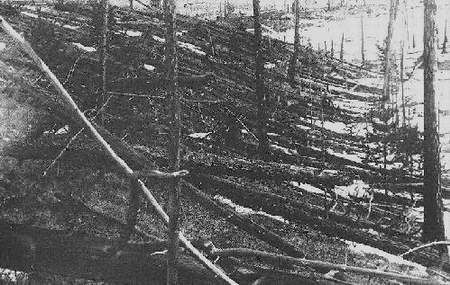
A violent explosion that took place over the valley of the Stony Tunguska river, in central Siberia, at 7.17 a.m. local time (0h 17m 11s UT), on Jun. 30, 1908, with the epicenter at 0°55' N, 101°57' E.13 This location is in the central Siberian area of Russia, about 1,000 km north of the town of Irkutsk and Lake Baikal. The event is now widely attributed in the astronomical community to the detonation of icy material from a comet in the Earth's atmosphere. The blast, which stripped or felled trees out to a radius of 40 km, burned reindeer to death, and sent the tents of nomads flying through the air, was preceded by the observed passage across the sky of a dazzling blue bolide, said to be almost as bright as the Sun, trailing a column of dust. The explosion registered at seismic stations across Eurasia, and produced fluctuations in atmospheric pressure strong enough to be detected by the recently invented barographs in Britain. Over the next few weeks, night skies over Europe and western Russia glowed brightly enough for people to read by. In the United States, the Smithsonian Astrophysical Observatory and the Mount Wilson Observatory observed a decrease in atmospheric transparency that lasted for several months. The size of the blast was later estimated to be between 10 and 15 megatons.
First impressions – or lack of them
The first report of the explosion was in the Irkutsk paper dated July 2, 1908, published two days after the explosion:
[T]he peasants saw a body shining very brightly (too bright for the naked eye) with a bluish-white light... The body was in the form of 'a pipe', i.e. cylindrical. The sky was cloudless, except that low down on the horizon, in the direction in which this glowing body was observed, a small dark cloud was noticed. It was hot and dry and when the shining body approached the ground (which was covered with forest at this point) it seemed to be pulverized, and in its place a loud crash, not like thunder, but as if from the fall of large stones or from gunfire was heard. All the buildings shook and at the same time a forked tongue of flames broke through the cloud. All the inhabitants of the village ran out into the street in panic. The old women wept, everyone thought that the end of the world was approaching.
S.B. Semenov, an eyewitness in the village of Vanovara about 60 km south of the explosion site, gave an excellent information:
I was sitting in the porch of the house at the trading station of Vanovara at breakfast time ... when suddenly in the north ... the sky was split in two and high above the forest the whole northern part of the sky appeared to be covered with fire. At that moment I felt great heat as if my shirt had caught fire; this heat came from the north side. I wanted to pull off my shirt and throw it away, but at that moment there was a bang in the sky, and a mighty crash was heard. I was thrown to the ground about three sajenes [about 7 meters] away from the porch and for a moment I lost consciousness... The crash was followed by noise like stones falling from the sky, or guns firing. The earth trembled, and when I lay on the ground I covered my head because I was afraid that stones might hit it.
Soviet mineralogist Leonid Kulik, who first investigated the event, initially assumed that it had been caused by the fall of a giant iron meteorite but the absence of any crater quickly led to this idea being abandoned. The cometary theory was first put forward in the 1930s by Soviet astronomer I. S. Astapovich1 and English meteorologist Francis Whipple20. However, other more exotic explanations later stemmed from the rumored existence of anomalous radiation at the site.
Was it an alien spacecraft?
In a science fiction story of 1946, Soviet author Alexander Kazantsev developed the idea that a nuclear-powered spacecraft from Mars, on a visit to collect fresh water from Lake Baikal, had exploded, showering the area in radioactivity. A prominent Soviet scientist, Alexei Zolotov, after a 17-year investigation, expanded on the nuclear explosion theory and Kazantsev's alien spacecraft speculation (TASS news release, mid-October 1976). According to Zolotov, a spaceship controlled by "beings from other worlds" may have caused the 1908 explosion. He imagined a nuclear-propelled craft that exploded accidentally due to a malfunction. Zolotov admits to problems with the theory, realizing that safety devices would probably prevent such a mishap, and noting that the actual area of destruction was "an amazing demonstration of pinpoint accuracy and humanitarianism." The science writer T. R. LeMaire developed this idea14, suggesting "The Tunguska blast's timing seems too fortuitous for an accident." He claims that a five-hour delay would make the target of destruction St. Petersburg, adding that a tiny change of course in space would have devastated populated areas of China or India.
Can we assume that the 'pilot' chose a cloudless day with excellent visibility from aloft to assure a safe drop? American Military strategy called for identical weather conditions; for a perfect strike on Hiroshima's industrial heart, the Enola Gay's bombardier was forbidden to release through a cloud cover: he had to see the target below. To maximize blast destruction, minimize radiation perils: the bomb was set to explode at a high altitude rather than against the ground. Similarly, the Siberian missile detonated high in the air, reducing or even eliminating fallout hazard.
A similar scenario has been advocated as a genuine scientific hypothesis by Mikhail Agrest and others. However, geochemist Kirill Florensky of the Soviet Academy of Sciences, who led expeditions to the site in 1958, 1961, and 1962, reported that the only radioactivity in the Tunguska trees could be explained as fallout from atomic bomb tests. Not surprisingly, interest in the possibility that an extraterrestrial spacecraft may have been involved continues unabated in the popular press. Most recently, in August 2004, a Russian expedition, led by Yuri Labvin, claimed to have recovered an "extraterrestrial device" from the scene of the incident. Its credibility was somewhat called into question by the group's mission, stated by Labvin to Pravda on Jul. 29, 2004, "to uncover evidence that will prove the fact that it was not a meteorite that rammed the Earth, but a UFO." The claimed discovery of precisely such evidence just a few weeks later invites a skeptical response. It will be interesting to see if the device is ever made available for genuine scientific investigation!
Was it antimatter?
The possibility that the Tunguska event could be explained by the collision of an antimatter meteorite was put forward in 1965 by by Clyde Cowan, C. R. Atluri, and Willard Libby5, and supported by Gentry8 in 1966. Cowan and his colleagues found a 1% jump in the radiocarbon (C-14) content of the rings of two trees, one in Los Angeles and the other, a 300-year-old Douglas fir, in Tucson, Arizona, for 1909, the year following the explosion. They proposed that the annihilation of an anti-rock in the atmosphere above the Tunguska site and caused the observed damage along with an increase in atmospheric radiocarbon. Unfortunately for this idea, careful C-14 measurements of a tree nearer the blast fail to show an increase in 1909 (Lerman et al. 1967). A possible explanation for the elevated C-14 content found by Cowan et al was suggested in 1977 by John Brown and David Hughes of the University of Sheffield4, who pointed out that sufficient neutrons to account for the American radiocarbon data could have come from the hot plasma generated by a comet's passage.
Was it a black hole?
Another spectacular explanation for the Tunguska catastrophe was hatched by Jackson and Ryan in 1973. They suggested that a black hole with a mass of 1022 to 1023 g would have the necessary energy (1023 ergs) to have caused the Tunguska destruction. Jackson and Ryan argued that the black hole would cause the destruction as it pierced through the Earth with the ease of cutting soft butter, exiting the planet through the Atlantic Ocean. In 1974, Beasley and Tinsley2 refuted the black hole theory on the basis that microbarographs, which recorded the air waves of the explosion, didn't record any anaomalous air waves from the predicted exit point in the Atlantic. This is vital to the black-hole theory because the exit of the black hole from the Earth would be expected to exhibit devastating effects similar to those at its entrance. The black-hole concept also does not explain the magnetite and silicate globules found in the explosion region, nor does it account for the anomalously bright night sky observed over Europe. Beasley and Tinsley conclude, "All the evidence favors the idea that the impact which caused the Tunguska catastrophe involved a body with characteristics like a cometary nucleus rather than a black hole."
No – it was (probably) a comet
Most most scientists are now reasonably content with the hypothesis that an exploding cometary nucleus or nucleus fragment was responsible for the Tunguska event. The generally accepted runs something like this: Above central Siberia on the morning of Jun. 30, 1908, a small comet or cometary fragment entered the atmosphere from behind the sun and moved in a southeast to northwest direction. It was composed of some 30,000 tons of water, methane, and ammonia ice with traces of silicates and iron oxides. Penetrating the atmosphere at approximately 60 km/s (130,000 mph), the object created an intense shock wave which wrapped tightly around its nose. As it descended, its nucleus exploded (possibly 3 times) approximately 8 km above the Earth's surface. A huge black cloud immediately appeared following the explosion which released 1023 ergs of energy. A heat wave with a temperature of approximately 16.6 million °C at the focus was generated that had a tree-scorching effect for a radius of 15 km. The heat wave was followed by air shock waves which disfigured or toppled 80 million trees occupying approximately 8000 km² of Siberian taiga, and triggered a seismic wave of Richter magnitude 5, yet left no crater. The dust from the tail of the comet moved away from the sun and provided anomalously bright night sky in Europe and parts of Western Russia.
And this may be a crater that part of it formed
In 2007, a team of Italian scientists from the University of Bologna claimed that a lake located 8 km north-north-west of the epicenter of the Tunguska airblast may occupy a crater hollowed out by a chunk of rock that hit the ground. Lake Cheko, the researchers said, fits the proportions of a small, bowl-shaped impact crater. Their investigation of the lake bottom's geology revealed a funnel-like shape not seen in other lakes nearby. Moreover, a geophysical survey of the lake bed turned up an unusual feature about 10 meters down which could be either compacted lake sediments or a buried fragment of space rock. The researchers plan to drill up to 10 meters below the lake bed to the anomaly picked up in the survey and determine whether it really is extraterrestrial in origin.23 For more on the Bologna team's research, see their website at http://www-th.bo.infn.it/tunguska/.
Bojan Set To Replace Torres

After being left out of the initial squad, Bojan could now be named and would be hopeful of making his first official appearance for La Roja in order to end speculation over which national team he will choose.
The 18-year-old's father is Serbian and their coach, Raddy Antic, is still hopeful that he can persuade the Barcelona goalscorer to play under him.
That statement forced Bojan to state last week that he wanted to play for Spain because he feels more Spanish, but until he actually does the rumours will persist.
"I am grateful for Antic's interest, but I want to continue growing and learning with Spain," Bojan said. "I hope to be lucky enough to be able to make my debut for them soon."
Vicente del Boque's side take on Bosnia and Armenia in the forthcoming World Cup qualifiers and that could give the youngster a chance to play, even if he only comes off the bench at the end of either game.
Torres' injury may not be the way that Bojan wanted to earn his call-up, but a door has opened after the Liverpool star pulled up during the draw with Aston Villa.
Ronaldinho Was Fantastic – Galliani

The Rossoneri did not have the start to the new season that they were looking for yesterday afternoon as, despite dominating from start to finish, they were humbled 2-1 at home by newly promoted Bologna.
"The result isn't good, but we were unlucky, even though we are not blameless,” said Galliani.
“In any case no one can say we didn't have a good transfer campaign, Zambrotta, Flamini, and Ronaldinho were the best on the pitch.
“We have to improve defensively but when your opponent finds the miracle goal it's tough. I am very upset for our fans, who came to San Siro in great numbers. In any case the team is there, we have an incredible number of stars, in every department, we will recover.
“If it were a boxing match we would have made more points but unfortunately only the goals count. We will have time to improve our tactics, I am confident, even though it hurts when I think about that shot by Valiani that went in just under the crossbar.”
Galliani then singled out Ronaldinho for praise. The Brazilian put in a mesmerising performance, creating Massimo Ambrosini’s goal as well as a host of other chances.
“Ronaldinho was fantastic, certainly the best on the pitch,” Galliani stated.
“We had plenty of chances that were created by him, unfortunately the balls didn't go in the goal but going forward we were much more dangerous than last season."
Milan will be looking to get their first points on the board in a fortnight’s time when they travel to Genoa for matchday two.
Serie A Team Of The Week: Round 1

Not a single one of last season's top four managed a win on opening weekend. Milan were stunned by Bologna, Juve shared the spoils with Fiorentina, and Inter found themselves held by Sampdoria. Elsewhere Torino thrashed newcomers Lecce, Udinese sank Palermo, and Catania edged Genoa.
What's more, Atalanta scraped past Siena and Chievo enjoyed a fruitful return with a 2-1 win over Reggina, but it was down to Lazio to put in the best performance of the weekend as they utterly thrashed ten-man Cagliari 4-1.
This week's line-up appears in a 3-5-2:
Sereni
Zambrotta - Grygera - Legrottaglie
Valiani - Aquilani - Hamsik - Ronaldinho - Inler
Di Natale - Zarate
Goalkeeper
Matteo Sereni- 8.0, Torino 3-0 Lecce
The shot-stopper made a number of stunning saves against Lecce to register a clean sheet for his side. The 33-year-old, who once played for Ipswich Town, showed that he still has what it takes to cut the mustard at the highest levels.
Defenders
Gianluca Zambrotta- 7.5, Milan 1-2 Bologna
He took some time to get into the game, but he was outstanding when he did. Having started on the left before switching to the right when Marek Jankulovski came on, the former Barcelona star formed a great partnership with Ronaldinho on the flank. He never stopped running and was a constant threat down the wings.
Zdenek Grygera- 7.5, Juventus 1-1 Fiorentina
The Czech defender has discovered that he can be an assist man as well as brilliant stopper. He always seemed to find space behind Fiorentina’s back line undetected. Indeed, he muscled his way into the box to set up Pavel Nedved's opener.
Nicola Legrottaglie- 7.0, Juventus 1-1 Fiorentina
The former Siena man has taken full responsibility at the back in Giorgio Chiellini’s absence. Was a commanding presence and kept Alberto Gilardino quiet for most of the game. Broke up the play and kept things organised.
Midfielders
Francesco Valiani- 8.0, Milan 1-2 Bologna
The versatile midfielder ensured his Serie A debut was a special one. He was outstanding throughout the match and stunned San Siro with a goal of the season contender ten minutes from time, stealing the points for the Rossoblu. A perfect start.
Alberto Aquilani- 8.0, Roma 1-1 Napoli
The Italian international is Roma’s unsung hero. He never stopped running and was a constant threat all over the pitch: in attack - holding up play - and in defence. His work rate was second to none and his goal was well taken.
Marek Hamsik- 8.5, Roma 1-1 Napoli
The Slovakian started where he left off from last term. Easily the man of the match, he ran the show for the Partenopei and earned his side a well deserved point with a brilliant, acrobatic strike. No wonder the club kept him this summer.
Ronaldinho- 8.0, Milan 1-2 Bologna
The Brazilian was back to his old tricks as he marked his debut in Serie A with some magical and dazzling play. His assist for Massimo Ambrosini was top-class and 'Dinho never stopped wowing the crowd. Fitter, sharper and more determined - it can only get better for him and the Rossoneri.
Gokhan Inler- 7.5, Udinese 3-1 Palermo
The Swiss international proved just why Udinese spent all summer trying to hold onto him. Every dangerous ball came via his feet as he created chance after chance for his side. He capped off a great performance with an unstoppable headed goal to ensure his side took all three points.
Strikers
Antonio Di Natale- 9.0, Udinese 3-1 Palermo
The hit-man fired his side to victory with a stunning brace. The two goals had Di Natale written all over them: a stunning run and finish and a fine lob over Marco Amelia. His display helped the Bianconeri get off to a flyer. Well done Toto!
Mauro Zarate- 8.0, Cagliari 1-4 Lazio
The Argentine grabbed a double - a well taken penalty and a clever lob - but that’s not all he contributed. He was a constant threat around the box and he linked up superbly with Goran Pandev. Showed incredible pace and hunger and Lazio will expect more of the same next week.
Sereni
Zambrotta - Grygera - Legrottaglie
Valiani - Aquilani - Hamsik - Ronaldinho - Inler
Di Natale - Zarate
Honourable Mentions
Among the better performers were Gianluigi Buffon (Juventus), Pietro Accardi (Sampdoria), Pavel Nedved (Juventus), Alberto Gilardino (Fiorentina) ,Alessandro Rosina (Torino), and Angelo Palombo (Sampdoria).
Also worthy of consideration were Daniele De Rossi (Roma), Gennaro Delvecchio (Sampdoria), Zlatan Ibrahimovic (Inter) , Marco Di Vaio (Bologna), and Ezequiel Lavezzi (Napoli).
Spalletti Wants One More Signing

The Giallorossi did not get off to the start they were looking for this new Serie A season, as they were held to a 1-1 draw at home by 10-man Napoli yesterday.
The capital outfit showed a few signs of fragility, and indeed could have lost the game were it not for a string of fine saves by goalkeeper Alexander Doni.
Despite recent big money signings of Julio Baptista and Jeremey Menez, coach Spalletti has admitted that he would possibly like to bring in one more player, someone to act as an alternative to currently injured attacking midfielder Rodrigo Taddei.
"If it were possible to serve up a substitute for Taddei [then yes], but without forcing things,” Spalletti told the Corriere dello Sport, before adding that Matteo Brighi would not be sold to Torino in an exchange with self-confessed Roma fan Davide Di Michele.
“I do not think that Brighi will leave, and there will be no exchange with Di Michele.
“In this respect the market is closed. Let's see what can happen in the final hours."
Other players to sign for Roma this summer are Liverpool’s John Arne Riise and Siena’s Simone Loria.
Camoranesi Writes Off Viola Title Chances

The two sides met at the Stadio Franchi last night, and Juve seemed destined to win after they took a first half lead through Pavel Nedved.
However, despite having chances to go 2-0 up, the Viola fought back to earn a point thanks to Alberto Gilardino’s 89th minute equaliser.
“We thought we could get the win,” said Camoranesi.
“We controlled the game to a certain extent and they didn't look like scoring.
“After we went 1-0 up we were in charge and I'm disappointed that it ended level.”
Before the season started, the Italian media listed five teams – Juve, Inter, Milan, Roma and Fiorentina – as those who would fight for the Scudetto, but Camoranesi believes that Cesare Prandelli’s men are not yet ready.
“We will fight to the wire for the Scudetto, but that seems too much for Fiorentina because they are still a young side,” he explained.
“The Viola will grow over the next two or three seasons but their target should be the top four.”
Juventus play host to Udinese in matchday two, while Fiorentina travel to rapidly-rising Napoli.
Defiant Deportivo Stun Madrid

Mista nodded the home team in front at the stadium where Los Merengues traditionally struggle and Alberto Lopo nodded in a winner after Ruud van Nistelrooy had levelled for the visitors.
In a week that has seen the Robinho saga reach new heights after the player stated publicly that he wanted to leave and join Chelsea, Madrid were unable to earn themselves some good press by chalking up a morale-boosting win.
Instead they will see more questions being asked about what is going on at the club after losing to a Deportivo side that looked refreshed and determined to make an impression at the start of the new campaign.
Having spent the early part of the summer focussed on prising Cristiano Ronaldo away from Manchester United without success, Madrid required some good news with recent reports suggesting that they were becoming desperate in the search for new signings.
David Villa and Santi Cazorla have both said no and now Robinho has caused even more uproar by making his disillusionment at the club clear only weeks after claiming that he wanted to stay and help the club win many trophies.
A convincing performance and a win were required to stop any critics from voicing their opinions, but Madrid could be in for a tough week after they were beaten in Galicia by a Depor side that look set to put the last few seasons behind them.
Miguel Ángel Lotina's players qualified for the UEFA Cup while the majority of teams were playing pre-season friendlies and it clearly did them not harm as they looked fresh and competitive in front of an enthsuiastic home crowd.
It has been several seasons since there has been much for the Depor fans to truly shout about after their slide from grace has seen them flirt with relegation more often than they have been close to the top four.
But throughout all that time, the team have still managed to maintain their form and receive an annual boost when Madrid visit and this year was no different.
Madrid did not play badly, but they were missing that spark which they have spent the last few weeks looking to sign and only Arjen Robben offerd any serious pace going forward early on.
In the opening two minutes however, Deportivo gave an indication of what they coulkd do when Mista met Pablo Álvarez's low cross and lifted the ball up and on to Iker Casillas' crossbar.
Moments later Robben set off on a mazy run which ended with him going down in the area and being accused of looking for a penalty by the unimpressed home team's defenders.
Having played in Split against Hajduk in midweek, Depor could have bene forgiven for having tired legs, but there was no signs of fatigue as they closed down well and hassled Madrid throughout.
In the 27th minute the breakthrough came when Andrés Guardado picked up a short corner and his cross picked out Mista who was then able to head the ball downward in to the corner of the net.
Casillas remained stationary in a game where he did not look to be at his best, while Gabriel Heinze clearly stepped away from the scorer just before the centre came over.
Before the break Madrid did have chances with the first seeing Daniel Aranzubia save from Robben with his legs before Marcelo almost scored from distance when his cross-cum-shot clipped the top of the bar.
Whatever Bernd Schuster said at the break had the desired effect as his side drew level within two minutes of the restart when Van Nistelrooy struck a first time effort past Aranzubia.
The home side could well have opted to sat back and try and stay calm with Madrid looking set to take the upper hand, but nothing was further from Deportivo players' minds.
Instead, in the 52nd minute a corner once again exposed Madrid's defensive frailties in the air as Lopo rose unmarked to flick the ball into the far corner of the net.
That may have been the end of the scoring, but it was not the end of the chances with Mahamadou Diarrá testing Aranzbuia but that was the best chance the Madrid could produce as they went in search of an equaliser.
There was some concerns for Depor when substitute Riki pulled up clutching the back of his leg before stretchered off with what appeared to be a serious hamstring injury.
But that will not spoil what was a great start to the season for the hosts, while Madrid will have to regroup before they play again in two weeks and hope that they can start winning headlines for the right reasons soon.
Subscribe to:
Comments (Atom)

 Posts
Posts


