Despite advances in parity in recent decades, white men in America on average still get paid more than women and minorities for doing the same work, by some accounts about 20 to 25 percent more.
A new study finds one reason: In satisfaction surveys, store customers and medical patients say they prefer white men, and managers frequently hire and set pay based on customer preferences.
In the study, researchers at four business schools showed study subjects a video featuring either a black male, a white female, or a white male actor playing the role of an employee helping a customer. Those viewing the white male were 19 percent more satisfied with the employee's performance, and they were also more satisfied with the store's cleanliness and appearance.
But the actors demonstrated the same scripted behaviors, and the store background, camera angles and lighting were identical.
"Customers, from students buying textbooks to patients in an examining room, are consistently biased in favor of white men," said David Hekman, assistant business professor at the University of Wisconsin–Milwaukee. "Because customer satisfaction is critical for organizational survival, business owners and managers will hire white men when possible and will pay lower salaries to the women and minorities they do hire."
In a separate aspect of the study, Hekman and his colleagues examined more than 10,000 medical patients' ratings of their doctors. Patients who received e-mail from their doctor were more satisfied with their doctor's competence and approachability, but only if the doctor was a white man.
Changes are needed in how customer satisfaction surveys are conducted, Hekman argues.
Surveys should target specific employee behaviors. For example, don't ask customers if they would recommend a physician, he suggests. Ask them how many times the doctor asked a patient if she had additional questions or understood key medical terms.
Anonymous customer feedback surveys should not be done, Hekman said. Customers should be identifiable and therefore at least somewhat accountable for their ratings. "People may do all sorts of bad things when they are anonymous," he said. "Just check out the reader postings on any blog."
The study, announced today, will be published in the Academy of Management Journal.
Showing posts with label money. Show all posts
Showing posts with label money. Show all posts
Friday, June 5, 2009

Friday, April 17, 2009
Google Suffers Several Negative Firsts in Quarter
It took a worldwide recession to put the Google growth machine in reverse.
The world's largest Internet search company marked several negative firsts in the quarter just passed, despite beating Wall Street's expectations in a tough economic environment.
Google saw its quarterly revenue decline compared to the previous quarter for the first time since it began publishing results in 2003.
Revenue for the first quarter fell to US$5.51 billion, down 3 percent compared to the fourth quarter of last year.
It was Google's worst quarterly performance since the $5.37 billion in revenue it reported in the second quarter last year.
Total advertising revenue, a key metric followed by analysts, fell 3 percent compared to the fourth quarter, its first drop on record.
The company's permanent head count also fell for the first time since it began reporting, to 20,164 compared to 20,222 in the fourth quarter, according to its Web site.
Google reported other negative firsts in the quarter, including the growth rate on Google Web sites, which fell 3 percent compared to the fourth quarter and hit a record low of 9 percent on a year-to-year basis.
Google Network Web site growth also turned negative for the first time on a year-to-year basis, by 3 percent.
The company's traffic acquisition cost as a percentage of revenue, at 26 percent, tied with the fourth quarter of last year as the lowest on record.
Google also reined in its capital spending, to just $262.8 million, the lowest level since the fourth quarter of 2005, when it spent $245.8 million and its revenue was around a third of what was reported Thursday.
The company's stock fell a slight 0.1 percent in after-market trading to $388.24.
The world's largest Internet search company marked several negative firsts in the quarter just passed, despite beating Wall Street's expectations in a tough economic environment.
Google saw its quarterly revenue decline compared to the previous quarter for the first time since it began publishing results in 2003.
Revenue for the first quarter fell to US$5.51 billion, down 3 percent compared to the fourth quarter of last year.
It was Google's worst quarterly performance since the $5.37 billion in revenue it reported in the second quarter last year.
Total advertising revenue, a key metric followed by analysts, fell 3 percent compared to the fourth quarter, its first drop on record.
The company's permanent head count also fell for the first time since it began reporting, to 20,164 compared to 20,222 in the fourth quarter, according to its Web site.
Google reported other negative firsts in the quarter, including the growth rate on Google Web sites, which fell 3 percent compared to the fourth quarter and hit a record low of 9 percent on a year-to-year basis.
Google Network Web site growth also turned negative for the first time on a year-to-year basis, by 3 percent.
The company's traffic acquisition cost as a percentage of revenue, at 26 percent, tied with the fourth quarter of last year as the lowest on record.
Google also reined in its capital spending, to just $262.8 million, the lowest level since the fourth quarter of 2005, when it spent $245.8 million and its revenue was around a third of what was reported Thursday.
The company's stock fell a slight 0.1 percent in after-market trading to $388.24.
Tuesday, February 3, 2009
Did Oprah cause the economic crash ?, Columnist: Phillip Tilley
Phillip Tilley: Did Oprah cause the economic crash? It is possible she is at least partly to blame. A year and a half ago the economy was humming along doing fine, consumer confidence was high and so was the stock market. Then Oprah had the author to the book “The Secret” on her program not once but twice to promote it. The Secret uses junk science to convince gullible people they can have whatever they want if they wish it into existence.
Ten million people bought the book and began secretly using the secret to get what they wanted. A new house or car, a big screen TV, and a vacation to Hawaii were all high on the lists of most people. When the secret wasn’t working, they used their credit cards and took out loans and got what they secretly wanted anyway because they believed the secret would secretly send them money to pay for it all so they didn’t worry. They are worried now because there is no money.
Now we are in the midst of an economic crisis. It is no secret that overextending your purchasing power and expecting a miracle will make you go into delinquency, foreclosure, and bankruptcy. I wonder how many of those readers of The Secret would secretly like to sue Oprah and the author of The Secret for influencing them to foolishly destroy their own lives? A real secret is that influence is one of the mechanisms of the money matrix.
If you don’t believe only ten million people could destroy the economy of the U.S. or that Oprah could influence a crisis in the economy I’ll show you how it works.
In 1996 Oprah had a guest talk about Mad Cow on her program and she said something to the effect that she wasn’t going to eat another burger. Texas cattlemen lost $12 million as cattle prices dropped and beef consumption went down. That was just $12 million in Texas. Total loses nation wide were likely $100 million. So in the past, Oprah has had an influence on at least one sector of the economy and if she endorses a book the author becomes a millionaire, count two of influence on the economy.
If you don’t think only 10 million people can crash the economy, consider how few people it takes to elect a President. There are 300 million Americans, half of them are eligible to vote, 150 million. Half of those eligible to vote actually register, 75 million.
On election day half of the registered voters vote, 37.5 million. 51% vote for the winning candidate, 19.25 million. That is only 6.4% of the U.S. population, and only 12.8% of eligible voters. You only need to influence 6.4% of eligible registered voters that actually vote to get elected!
10 million people is only 6.6% of consumers. I wouldn’t say Oprah was malicious or intended to crash the economy, she was merely a tool of influence for the Money Matrix. With the Butterfly Effect, what affects 10 million affects us all. A trail of information leads only to the truth. Wake up people, the money matrix has you.
Phillip Tilley is author of The Money Matrix of the New World Order and other articles
Ten million people bought the book and began secretly using the secret to get what they wanted. A new house or car, a big screen TV, and a vacation to Hawaii were all high on the lists of most people. When the secret wasn’t working, they used their credit cards and took out loans and got what they secretly wanted anyway because they believed the secret would secretly send them money to pay for it all so they didn’t worry. They are worried now because there is no money.
Now we are in the midst of an economic crisis. It is no secret that overextending your purchasing power and expecting a miracle will make you go into delinquency, foreclosure, and bankruptcy. I wonder how many of those readers of The Secret would secretly like to sue Oprah and the author of The Secret for influencing them to foolishly destroy their own lives? A real secret is that influence is one of the mechanisms of the money matrix.
If you don’t believe only ten million people could destroy the economy of the U.S. or that Oprah could influence a crisis in the economy I’ll show you how it works.
In 1996 Oprah had a guest talk about Mad Cow on her program and she said something to the effect that she wasn’t going to eat another burger. Texas cattlemen lost $12 million as cattle prices dropped and beef consumption went down. That was just $12 million in Texas. Total loses nation wide were likely $100 million. So in the past, Oprah has had an influence on at least one sector of the economy and if she endorses a book the author becomes a millionaire, count two of influence on the economy.
If you don’t think only 10 million people can crash the economy, consider how few people it takes to elect a President. There are 300 million Americans, half of them are eligible to vote, 150 million. Half of those eligible to vote actually register, 75 million.
On election day half of the registered voters vote, 37.5 million. 51% vote for the winning candidate, 19.25 million. That is only 6.4% of the U.S. population, and only 12.8% of eligible voters. You only need to influence 6.4% of eligible registered voters that actually vote to get elected!
10 million people is only 6.6% of consumers. I wouldn’t say Oprah was malicious or intended to crash the economy, she was merely a tool of influence for the Money Matrix. With the Butterfly Effect, what affects 10 million affects us all. A trail of information leads only to the truth. Wake up people, the money matrix has you.
Phillip Tilley is author of The Money Matrix of the New World Order and other articles
Monday, November 24, 2008
Five Reasons You Should Consider Generating Your Own Green Energy
Over the past six months, oil prices have plunged more than 50 percent, renewable energy company asset values have taken an even bigger dive, and financial institutions have collapsed completely, leading to a worldwide credit crunch.
Is this really the best time for your company to be thinking about generating renewable energy onsite?
Before answering, consider these forecasts by the International Energy Administration (IEA) in its recent World Energy Outlook 2008:
-- Energy is going to get more expensive, with oil reaching $200 per barrel by 2030.
-- Carbon-intensive energy, which comprises well over half of the energy in the United States, is going to get much more expensive-in part due to a cap on carbon that could reach $180 per ton.
-- The price and supply of fossil fuels will continue to be volatile.
In that context, it's clear: Companies can't afford not to think about investing in renewable energy, especially those with high energy-to-raw-material cost ratios, such as firms in agriculture, food processing, metal refining, paper manufacturing, and chemicals.
What follows are five key reasons why you should consider generating renewable energy onsite to power up your business.
Renewable Energy is Beating the Grid
In some regions, the cost of generating onsite renewable energy is already beating electricity bought from the grid. This "grid parity" is currently happening in places like California, Hawaii and Japan, where electricity costs are high and renewable resources are abundant. By 2012, Australia and Italy will likely achieve grid parity, and by 2015 much more of the United States will as well.
Threatened Supply and Hungry Demand Build the Case for Self-Production
Oil production is expanding to regions with increasingly unstable governments and crippling poverty, such as Iran, Russia, and Qatar, which together hold 56 percent of known new oil reserves.
On the demand side, the world is hungrier than ever: Even with the extremely high per-capita oil needs of OECD countries, fully 80 percent of projected new demand is coming from China, India, and the Middle East, while 1.6 billion people around the world still go without any electricity. As for logistics, the bulk of oil moves through international waters where there is growing banditry, such as the $100 million oil tanker heist by Somali pirates that is still unresolved. The result: The fossil fuel supply chain poses tremendous uncertainty on both price and physical delivery.
Carbon Legislation is Pushing Up Costs
Carbon cap-and-trade regulations, in some form or another, are descending on economies around the world. Already underway for several years, the European Union Emission Trading Scheme charges European heavy emitters $21.39 for every ton of carbon above their cap. In October, the U.S. inaugurated its first cap-and-trade program, the Regional Greenhouse Gas Initiative (RGGI), which regulates utilities in the Northeast with a cost of $3.07 per ton. Regulation is just around the corner for other parts of the U.S., as well as for China and Canada. The IEA, an energy policy advisor to 28 member countries, predicts that by 2030, the average carbon prices will climb to $90 or even $180 per ton.
In addition to cap-and-trade regulations, low-carbon product standards and border tax adjustments also will put pressure on supply chains and buyer demand. All this means that carbon-intensive energy is a growing liability, whether at your own operations, upstream with suppliers, or downstream with the use of the products you sell.
Incentives for Onsite Renewables Production are Rising
"Feed-in tariffs," which require utilities to connect small, onsite renewable projects to the grid and pay their generators for surplus energy generated, are gaining traction. Countries such as Germany and Spain have adopted such policies successfully, and others like the U.S. (in California) and China are in the midst of implementing and scaling them up.
Creative Finance Options Abound
There are numerous ways to gather the resources to make onsite projects happen. Thanks to the grid, energy service companies can provide some or all of the financing needed. The grid also enables creative partnerships. For example, in partnership with Xcel Energy, Colorado's Aspen Skiing Company recently financed $1.1 million for a 147-kilowatt solar energy array. Of the energy produced, a third goes to a local school, and two-thirds is sold back to the grid, with profits given to Aspen Skiing Company.
There is a good chance you will find financing for onsite renewable energy projects by exploring partnerships with foundations or exploring funding available in carbon markets for carbon-offsets projects.
With the energy crisis likely to outlast the current economic crisis, investing in onsite renewable energy generation can insulate your company from the shocks, scarcity, and rising prices of energy. And with recent political discussions about a "New Green Deal" and a climate change "Manhattan Project," it's even possible that governments will add to or reconfigure the $300 billion in energy subsidies around the world.
So, in response to the question we started with: Is this really the best time for your company to be thinking about generating renewable energy onsite?
Yes, now more than ever.
Is this really the best time for your company to be thinking about generating renewable energy onsite?
Before answering, consider these forecasts by the International Energy Administration (IEA) in its recent World Energy Outlook 2008:
-- Energy is going to get more expensive, with oil reaching $200 per barrel by 2030.
-- Carbon-intensive energy, which comprises well over half of the energy in the United States, is going to get much more expensive-in part due to a cap on carbon that could reach $180 per ton.
-- The price and supply of fossil fuels will continue to be volatile.
In that context, it's clear: Companies can't afford not to think about investing in renewable energy, especially those with high energy-to-raw-material cost ratios, such as firms in agriculture, food processing, metal refining, paper manufacturing, and chemicals.
What follows are five key reasons why you should consider generating renewable energy onsite to power up your business.
Renewable Energy is Beating the Grid
In some regions, the cost of generating onsite renewable energy is already beating electricity bought from the grid. This "grid parity" is currently happening in places like California, Hawaii and Japan, where electricity costs are high and renewable resources are abundant. By 2012, Australia and Italy will likely achieve grid parity, and by 2015 much more of the United States will as well.
Threatened Supply and Hungry Demand Build the Case for Self-Production
Oil production is expanding to regions with increasingly unstable governments and crippling poverty, such as Iran, Russia, and Qatar, which together hold 56 percent of known new oil reserves.
On the demand side, the world is hungrier than ever: Even with the extremely high per-capita oil needs of OECD countries, fully 80 percent of projected new demand is coming from China, India, and the Middle East, while 1.6 billion people around the world still go without any electricity. As for logistics, the bulk of oil moves through international waters where there is growing banditry, such as the $100 million oil tanker heist by Somali pirates that is still unresolved. The result: The fossil fuel supply chain poses tremendous uncertainty on both price and physical delivery.
Carbon Legislation is Pushing Up Costs
Carbon cap-and-trade regulations, in some form or another, are descending on economies around the world. Already underway for several years, the European Union Emission Trading Scheme charges European heavy emitters $21.39 for every ton of carbon above their cap. In October, the U.S. inaugurated its first cap-and-trade program, the Regional Greenhouse Gas Initiative (RGGI), which regulates utilities in the Northeast with a cost of $3.07 per ton. Regulation is just around the corner for other parts of the U.S., as well as for China and Canada. The IEA, an energy policy advisor to 28 member countries, predicts that by 2030, the average carbon prices will climb to $90 or even $180 per ton.
In addition to cap-and-trade regulations, low-carbon product standards and border tax adjustments also will put pressure on supply chains and buyer demand. All this means that carbon-intensive energy is a growing liability, whether at your own operations, upstream with suppliers, or downstream with the use of the products you sell.
Incentives for Onsite Renewables Production are Rising
"Feed-in tariffs," which require utilities to connect small, onsite renewable projects to the grid and pay their generators for surplus energy generated, are gaining traction. Countries such as Germany and Spain have adopted such policies successfully, and others like the U.S. (in California) and China are in the midst of implementing and scaling them up.
Creative Finance Options Abound
There are numerous ways to gather the resources to make onsite projects happen. Thanks to the grid, energy service companies can provide some or all of the financing needed. The grid also enables creative partnerships. For example, in partnership with Xcel Energy, Colorado's Aspen Skiing Company recently financed $1.1 million for a 147-kilowatt solar energy array. Of the energy produced, a third goes to a local school, and two-thirds is sold back to the grid, with profits given to Aspen Skiing Company.
There is a good chance you will find financing for onsite renewable energy projects by exploring partnerships with foundations or exploring funding available in carbon markets for carbon-offsets projects.
With the energy crisis likely to outlast the current economic crisis, investing in onsite renewable energy generation can insulate your company from the shocks, scarcity, and rising prices of energy. And with recent political discussions about a "New Green Deal" and a climate change "Manhattan Project," it's even possible that governments will add to or reconfigure the $300 billion in energy subsidies around the world.
So, in response to the question we started with: Is this really the best time for your company to be thinking about generating renewable energy onsite?
Yes, now more than ever.
Global warming will help Russian economy – US intelligence
Global climate change is supposed to contribute to Russian economy, according to Michael McConnell, director of US national intelligence. The US National Security Council has published a 100-page report titled ‘Global Trends 2025: A Transformed World’ that takes a long-term view of the future.
It is said in the document that by 2025 Russia’s profit from the rising temperatures on the Earth will be the largest of all the countries. One of the reasons is the expected lengthening of the sowing term, but the key factor would be an easier access to oil and gas fields in Siberia and in the North, including the Arctic shelf. This will be a great success for the Russian economy, according to the NSC report, and the Arctic waterway would also open huge prospects for Russia.
However, the authors of the study warn of the possible threats: the infrastructure of Russia’s Arctic territories may be destroyed, and also new technologies may be needed to exploit fuel fields in the area.
The report also noted that by 2025 China was likely to have the world's second largest economy, emerge as a major military power, be the largest importer of natural resources and the largest contributor to world pollution. India will have either the third or second largest economy and will press to become "one of the significant poles of this new world". As for Russia, it would also be part of that group, but only if it expanded and diversified its economy and then integrated into the world global economy, said McConnell.
It is said in the document that by 2025 Russia’s profit from the rising temperatures on the Earth will be the largest of all the countries. One of the reasons is the expected lengthening of the sowing term, but the key factor would be an easier access to oil and gas fields in Siberia and in the North, including the Arctic shelf. This will be a great success for the Russian economy, according to the NSC report, and the Arctic waterway would also open huge prospects for Russia.
However, the authors of the study warn of the possible threats: the infrastructure of Russia’s Arctic territories may be destroyed, and also new technologies may be needed to exploit fuel fields in the area.
The report also noted that by 2025 China was likely to have the world's second largest economy, emerge as a major military power, be the largest importer of natural resources and the largest contributor to world pollution. India will have either the third or second largest economy and will press to become "one of the significant poles of this new world". As for Russia, it would also be part of that group, but only if it expanded and diversified its economy and then integrated into the world global economy, said McConnell.
Wednesday, November 12, 2008
14 Big Businesses That Started in a Recession
It might seem counterintuitive to start a new business when the economy is in the dumps. But a recession can actually be the ideal time for launching a company. In fact, many well-known and successful organizations were born during an economic slump.
Why do these companies succeed? Usually it's because the founders recognized a market need and filled it. Identifying that need — whether it’s related to entertainment, travel or even streamlining how businesses operate — is the key to any thriving enterprise, regardless of the economic climate in which it begins. The following major corporations made it big during recessions by doing just that.
Hyatt Corp. opened its first hotel’s doors at the Los Angeles International Airport during the Eisenhower recession (1957 to 1958). The chain rose to worldwide fame in the following decades and now operates more than 365 hotels in 25 countries with premium services such as wifi hotspots.
Burger King Corp., with its flame-broiled burgers, is another recession startup. The company began in 1954 when James McLamore and David Edgerton opened a Burger King restaurant in Miami, Fla. During another recession in 1957, the company introduced its successful signature burger — the Whopper. Today, the company operates more than 11,100 locations in 65 countries.
IHOP Corp. is another star from the Eisenhower recession. The first restaurant in the now national chain opened its doors July1958 in Toluca Lake, Calif. Owners Al and Jerry Lapin were at the helm of the fast growing company, which began franchising just three years later. Today, there are more than 1,300 locations across the U.S.
The Jim Henson Company was created by famed puppeteer Jim Henson in 1958. Henson's business was responsible for some of the best-known puppet characters of all time including Miss Piggy, Kermit the Frog and Elmo. Today, the privately held company is managed by Henson's children and continues to thrive by creating popular kids-friendly shows and movies.
LexisNexis is a research hub for the law, media and more. The company, originally a government contractor, began its LexisNexis computerized legal research service during the 1973 oil crisis that rocked the country into steep economic slump. The now Web-based service is used in 100 countries by individuals in law, government, education and business.
FedEx Corp. began operations on April 17, 1973 as Federal Express, a nod to the Federal Reserve, with whom founder Frederick W. Smith had hoped to get a contract. He didn't, but the company that delivered 186 packages to 25 cities on its first night of operations now manages more than 7.5 million shipments everyday worldwide.
Microsoft Corp. wasn't always the jaw-dropping enterprise it is today. In 1975, when it was created by Harvard University dropout Bill Gates, Microsoft was just a little company in Albuquerque, N.M. It dealt in rudimentary computing languages and began its climb to business stardom with the success of MS-DOS, which was sold and marketed to IBM Corp. and then-IBM clones. Today, the company is estimated to earn more than $60 billion in revenue per year and is branching into new areas including VoIP and CRM.
CNN might be a news giant now, but in recession-plagued 1980, it was a little-known station called The Cable Network News. It revolutionized how people received information when it premiered as the first 24-hour all-news channel. Today, 1.5 billion people across the globe watch CNN.
MTV Networks brought something new and different to the music scene when it debuted in the economic slump of 1981. Intended to be an all-music-video channel, MTV used VJs (video jockeys) to host programs and facilitate transitions between videos. Today, MTV is a global brand with dozens of shows, music-related and not.
Trader Joe's started as a chain of convenience stores called Pronto Markets in the slow financial times of 1958. In 1967, the company changed its name to Trader Joe's and began to carry unique grocery items under its own brand. The company now operates more than 280 stores in the U.S.
Wikipedia Foundation Inc. was born during the recent post-9/11 recession. Established in January 2001, the online encyclopedia had more than 100,000 entries by 2003. Today it is home to more than 2.5 million articles and continues to grow.
Sports Illustrated magazine was launched on August 16, 1954, at the tail-end of a recession. The magazine benefitted from fortunate timing as a boom in professional sports exploded soon after its founding. Sports Illustrated now sells about 3 million copies in the U.S. each week.
GE (General Electric Co.) was established in 1876 by famed American inventor Thomas Edison. In the middle of the Panic of 1873, a six-year recession, Edison created one of the best-known inventions of all time — the incandescent light bulb. In terms of market capitalization, GE is now the third largest company in the world. The enterprise has evolved from a manufacturing-strong business to an enterprise earning more than 50 percent of its revenue from its financial services division.
HP (Hewlett-Packard Development Company LP) was inauspiciously born in a Palo Alto garage at the end of the Great Depression. The electronic company, initially supported by a mere $538 investment, has grown into the first technology business to exceed $100 billion in revenue, earning $104 billion in 2007. It now operates in nearly every country in the world.
Recessions, however, aren’t advantageous only to start-ups. Pre-existing companies can also make incredible gains in years where the economy is down. Some of the most recent success stories are those of Google, PayPal and Salesforce.com Inc. From 2000 to 2001 each of these companies thrived, leading PayPal to go public in 2002, followed by Google and Salesforce.com in 2004.
Why do these companies succeed? Usually it's because the founders recognized a market need and filled it. Identifying that need — whether it’s related to entertainment, travel or even streamlining how businesses operate — is the key to any thriving enterprise, regardless of the economic climate in which it begins. The following major corporations made it big during recessions by doing just that.
Hyatt Corp. opened its first hotel’s doors at the Los Angeles International Airport during the Eisenhower recession (1957 to 1958). The chain rose to worldwide fame in the following decades and now operates more than 365 hotels in 25 countries with premium services such as wifi hotspots.
Burger King Corp., with its flame-broiled burgers, is another recession startup. The company began in 1954 when James McLamore and David Edgerton opened a Burger King restaurant in Miami, Fla. During another recession in 1957, the company introduced its successful signature burger — the Whopper. Today, the company operates more than 11,100 locations in 65 countries.
IHOP Corp. is another star from the Eisenhower recession. The first restaurant in the now national chain opened its doors July1958 in Toluca Lake, Calif. Owners Al and Jerry Lapin were at the helm of the fast growing company, which began franchising just three years later. Today, there are more than 1,300 locations across the U.S.
The Jim Henson Company was created by famed puppeteer Jim Henson in 1958. Henson's business was responsible for some of the best-known puppet characters of all time including Miss Piggy, Kermit the Frog and Elmo. Today, the privately held company is managed by Henson's children and continues to thrive by creating popular kids-friendly shows and movies.
LexisNexis is a research hub for the law, media and more. The company, originally a government contractor, began its LexisNexis computerized legal research service during the 1973 oil crisis that rocked the country into steep economic slump. The now Web-based service is used in 100 countries by individuals in law, government, education and business.
FedEx Corp. began operations on April 17, 1973 as Federal Express, a nod to the Federal Reserve, with whom founder Frederick W. Smith had hoped to get a contract. He didn't, but the company that delivered 186 packages to 25 cities on its first night of operations now manages more than 7.5 million shipments everyday worldwide.
Microsoft Corp. wasn't always the jaw-dropping enterprise it is today. In 1975, when it was created by Harvard University dropout Bill Gates, Microsoft was just a little company in Albuquerque, N.M. It dealt in rudimentary computing languages and began its climb to business stardom with the success of MS-DOS, which was sold and marketed to IBM Corp. and then-IBM clones. Today, the company is estimated to earn more than $60 billion in revenue per year and is branching into new areas including VoIP and CRM.
CNN might be a news giant now, but in recession-plagued 1980, it was a little-known station called The Cable Network News. It revolutionized how people received information when it premiered as the first 24-hour all-news channel. Today, 1.5 billion people across the globe watch CNN.
MTV Networks brought something new and different to the music scene when it debuted in the economic slump of 1981. Intended to be an all-music-video channel, MTV used VJs (video jockeys) to host programs and facilitate transitions between videos. Today, MTV is a global brand with dozens of shows, music-related and not.
Trader Joe's started as a chain of convenience stores called Pronto Markets in the slow financial times of 1958. In 1967, the company changed its name to Trader Joe's and began to carry unique grocery items under its own brand. The company now operates more than 280 stores in the U.S.
Wikipedia Foundation Inc. was born during the recent post-9/11 recession. Established in January 2001, the online encyclopedia had more than 100,000 entries by 2003. Today it is home to more than 2.5 million articles and continues to grow.
Sports Illustrated magazine was launched on August 16, 1954, at the tail-end of a recession. The magazine benefitted from fortunate timing as a boom in professional sports exploded soon after its founding. Sports Illustrated now sells about 3 million copies in the U.S. each week.
GE (General Electric Co.) was established in 1876 by famed American inventor Thomas Edison. In the middle of the Panic of 1873, a six-year recession, Edison created one of the best-known inventions of all time — the incandescent light bulb. In terms of market capitalization, GE is now the third largest company in the world. The enterprise has evolved from a manufacturing-strong business to an enterprise earning more than 50 percent of its revenue from its financial services division.
HP (Hewlett-Packard Development Company LP) was inauspiciously born in a Palo Alto garage at the end of the Great Depression. The electronic company, initially supported by a mere $538 investment, has grown into the first technology business to exceed $100 billion in revenue, earning $104 billion in 2007. It now operates in nearly every country in the world.
Recessions, however, aren’t advantageous only to start-ups. Pre-existing companies can also make incredible gains in years where the economy is down. Some of the most recent success stories are those of Google, PayPal and Salesforce.com Inc. From 2000 to 2001 each of these companies thrived, leading PayPal to go public in 2002, followed by Google and Salesforce.com in 2004.
Saturday, November 1, 2008
U.S. Stocks Post Biggest Weekly Gain Since 1974 on Valuations
Nov. 1 (Bloomberg) -- U.S. stocks staged their steepest weekly surge in 34 years after the Federal Reserve's interest- rate cut and signs the credit crisis is ebbing boosted equities trading at the lowest valuations in two decades.
The Standard & Poor's 500 Index still finished October with its worst monthly drop since 1987. Home Depot Inc., Walt Disney Co. and Target Corp. increased more than 15 percent, leading gains by companies that depend on discretionary spending by consumers. Verizon Communications Inc. rose the most in six years after sales beat estimates. PNC Financial Services Group Inc. and BB&T Corp. advanced after the Treasury agreed to infuse capital in at least 23 regional banks.
The S&P 500 climbed 10 percent to 968.75 this week, while the Dow Jones Industrial Average rose 11 percent to 9,325.01. Both rallied the most since October 1974 after closing at five- year lows on Oct. 27. The MSCI World Index of 23 developed markets jumped 9.8 percent to 957.25.
``There's a lot of inexpensive merchandise out there,'' said Warren Koontz, who oversees $2.5 billion as chief investment officer for large, value stocks at Loomis Sayles & Co. in Boston. ``The most I've seen in 25 years.''
The S&P 500 still sank 17 percent in October. The retreat drove its price-to-earnings ratio based on estimated 2008 profit to 10.7 on Oct. 27, the cheapest compared with the multiple using reported results since 1985.
$9.5 Trillion Lost
The October sell-off erased more than $9.5 trillion from the value of stocks worldwide, almost one-third of the total value wiped out this year, as credit-related losses and writedowns by financial firms approached $700 billion. The S&P 500 has slumped 34 percent in 2008.
Benchmark indexes for 67 of 68 markets tracked by MSCI Inc. declined in October, with 37 losing at least 20 percent. Bulgaria, Peru and Argentina did the worst, plunging more than 36 percent. Pakistan gained less than 0.1 percent.
All 10 industries in the S&P 500 advanced this week, led by consumer discretionary companies, after the Fed cut its target rate for overnight loans between banks to 1 percent, matching a half-century low. The companies gained even after Commerce Department data released Oct. 30 showed consumer spending dropped at a 3.1 percent annual rate in the third quarter, the most since 1980. The economy as a whole contracted at a 0.3 percent pace, its worst performance since 2001.
Home Depot, Disney
Home Depot, the world's largest home-improvement retailer, rose 27 percent to $23.59 for the steepest rally since it began trading in 1981. Disney, the No. 2 U.S. media company, advanced 15 percent to $25.91, the most since February 2004.
Target added 22 percent, the most in at least 28 years, to $40.12. William Ackman, whose hedge fund owns 10 percent of the discount retailer, said it should form a separate company to manage its $25 billion in real estate.
Staples Inc. climbed 35 percent, the most in its 19 years as a public company, to $19.43. The biggest U.S. office-supplies retailer forecast third-quarter profit exceeding some analysts' estimates and reiterated its long-term earnings projections.
Office Depot Inc., the second-largest office-supplies retailer, more than doubled to $3.60 for the biggest gain in the S&P 500. The 22 percent advance by retailers was the biggest among the 24 industry groups in the S&P 500, followed by real- estate companies. Homebuilders surged 34 percent.
Starbucks Corp. jumped 36 percent, the most in its 16-year history. The world's largest coffee-shop chain said October same- store sales in the U.S. suggest declines have ``bottomed out.''
Verizon added 18 percent to $29.67. The second-largest U.S. phone company added more subscribers than analysts estimated, driving profit up 31 percent.
PNC, BB&T Gain
PNC, whose pending acquisition of National City Corp. will make it the fifth-largest U.S. bank by deposits, gained 13 percent to $66.67. BB&T, the North Carolina-based lender, added 11 percent to $35.85.
The two regional banks are among at least 23 financial institutions invited to accept capital infusions as the Treasury rolls out the second half of its $250 billion package to shore up lenders and thaw frozen credit markets.
Stocks ``overshot to the downside given almost $5 trillion stimulus into the marketplace in terms of liquidity and capitalization done by governments around the world,'' said David Goerz, chief investment officer at Highmark Capital Management in San Francisco, which oversees $20 billion. ``I wouldn't want to be betting against them at this point.''
The cost of using options to insure against declines in stock prices fell for the first time in 10 weeks. The VIX, as the Chicago Board Options Exchange Volatility Index is known, slid 24 percent to 59.89, the biggest weekly drop since August 2007.
Yields on Treasury securities climbed as stock-market gains curbed demand for fixed-rate investments. The benchmark 10-year note's yield rose to 3.96 percent from 3.69 percent.
`Significant' Buyback
Apple Inc., the maker of Macintosh computers and the iPhone, rose 12 percent to $107.59. Sanford C. Bernstein & Co. said a ``significant'' share repurchase may boost earnings.
Insurance companies were the biggest decliners among the 43 S&P 500 stocks that slumped this week as investment losses threatened profits and credit ratings.
Hartford Financial Services Group Inc., the insurer that got an investment from Germany's Allianz SE this month, fell 58 percent to $10.32 after reporting its first unprofitable quarter in five years.
Cigna Corp., the Philadelphia-based health insurer, fell 32 percent to $16.30 after reporting a 53 percent profit decline because of shrinking health-plan membership and falling stock prices in its annuities business. Assurant Inc., the home insurer, retreated 31 percent to $25.48 after posting a third- quarter loss on investments and costs for two U.S. hurricanes.
$684 Billion Lost
S&P 500 companies are headed for their fifth straight quarter of declining profits. For the 360 that have reported third-quarter results, earnings fell 11 percent. Excluding financial institutions, profit rose 16 percent.
Industry and government reports next week are forecast to show manufacturing contracted at the fastest pace since 2001 while employers cut the most jobs since March 2003 in October, according to the median forecasts of economists in a Bloomberg survey. Americans go to the polls Nov. 4 to elect either Democrat Barack Obama or Republican John McCain to succeed President George W. Bush, a Republican.
The Standard & Poor's 500 Index still finished October with its worst monthly drop since 1987. Home Depot Inc., Walt Disney Co. and Target Corp. increased more than 15 percent, leading gains by companies that depend on discretionary spending by consumers. Verizon Communications Inc. rose the most in six years after sales beat estimates. PNC Financial Services Group Inc. and BB&T Corp. advanced after the Treasury agreed to infuse capital in at least 23 regional banks.
The S&P 500 climbed 10 percent to 968.75 this week, while the Dow Jones Industrial Average rose 11 percent to 9,325.01. Both rallied the most since October 1974 after closing at five- year lows on Oct. 27. The MSCI World Index of 23 developed markets jumped 9.8 percent to 957.25.
``There's a lot of inexpensive merchandise out there,'' said Warren Koontz, who oversees $2.5 billion as chief investment officer for large, value stocks at Loomis Sayles & Co. in Boston. ``The most I've seen in 25 years.''
The S&P 500 still sank 17 percent in October. The retreat drove its price-to-earnings ratio based on estimated 2008 profit to 10.7 on Oct. 27, the cheapest compared with the multiple using reported results since 1985.
$9.5 Trillion Lost
The October sell-off erased more than $9.5 trillion from the value of stocks worldwide, almost one-third of the total value wiped out this year, as credit-related losses and writedowns by financial firms approached $700 billion. The S&P 500 has slumped 34 percent in 2008.
Benchmark indexes for 67 of 68 markets tracked by MSCI Inc. declined in October, with 37 losing at least 20 percent. Bulgaria, Peru and Argentina did the worst, plunging more than 36 percent. Pakistan gained less than 0.1 percent.
All 10 industries in the S&P 500 advanced this week, led by consumer discretionary companies, after the Fed cut its target rate for overnight loans between banks to 1 percent, matching a half-century low. The companies gained even after Commerce Department data released Oct. 30 showed consumer spending dropped at a 3.1 percent annual rate in the third quarter, the most since 1980. The economy as a whole contracted at a 0.3 percent pace, its worst performance since 2001.
Home Depot, Disney
Home Depot, the world's largest home-improvement retailer, rose 27 percent to $23.59 for the steepest rally since it began trading in 1981. Disney, the No. 2 U.S. media company, advanced 15 percent to $25.91, the most since February 2004.
Target added 22 percent, the most in at least 28 years, to $40.12. William Ackman, whose hedge fund owns 10 percent of the discount retailer, said it should form a separate company to manage its $25 billion in real estate.
Staples Inc. climbed 35 percent, the most in its 19 years as a public company, to $19.43. The biggest U.S. office-supplies retailer forecast third-quarter profit exceeding some analysts' estimates and reiterated its long-term earnings projections.
Office Depot Inc., the second-largest office-supplies retailer, more than doubled to $3.60 for the biggest gain in the S&P 500. The 22 percent advance by retailers was the biggest among the 24 industry groups in the S&P 500, followed by real- estate companies. Homebuilders surged 34 percent.
Starbucks Corp. jumped 36 percent, the most in its 16-year history. The world's largest coffee-shop chain said October same- store sales in the U.S. suggest declines have ``bottomed out.''
Verizon added 18 percent to $29.67. The second-largest U.S. phone company added more subscribers than analysts estimated, driving profit up 31 percent.
PNC, BB&T Gain
PNC, whose pending acquisition of National City Corp. will make it the fifth-largest U.S. bank by deposits, gained 13 percent to $66.67. BB&T, the North Carolina-based lender, added 11 percent to $35.85.
The two regional banks are among at least 23 financial institutions invited to accept capital infusions as the Treasury rolls out the second half of its $250 billion package to shore up lenders and thaw frozen credit markets.
Stocks ``overshot to the downside given almost $5 trillion stimulus into the marketplace in terms of liquidity and capitalization done by governments around the world,'' said David Goerz, chief investment officer at Highmark Capital Management in San Francisco, which oversees $20 billion. ``I wouldn't want to be betting against them at this point.''
The cost of using options to insure against declines in stock prices fell for the first time in 10 weeks. The VIX, as the Chicago Board Options Exchange Volatility Index is known, slid 24 percent to 59.89, the biggest weekly drop since August 2007.
Yields on Treasury securities climbed as stock-market gains curbed demand for fixed-rate investments. The benchmark 10-year note's yield rose to 3.96 percent from 3.69 percent.
`Significant' Buyback
Apple Inc., the maker of Macintosh computers and the iPhone, rose 12 percent to $107.59. Sanford C. Bernstein & Co. said a ``significant'' share repurchase may boost earnings.
Insurance companies were the biggest decliners among the 43 S&P 500 stocks that slumped this week as investment losses threatened profits and credit ratings.
Hartford Financial Services Group Inc., the insurer that got an investment from Germany's Allianz SE this month, fell 58 percent to $10.32 after reporting its first unprofitable quarter in five years.
Cigna Corp., the Philadelphia-based health insurer, fell 32 percent to $16.30 after reporting a 53 percent profit decline because of shrinking health-plan membership and falling stock prices in its annuities business. Assurant Inc., the home insurer, retreated 31 percent to $25.48 after posting a third- quarter loss on investments and costs for two U.S. hurricanes.
$684 Billion Lost
S&P 500 companies are headed for their fifth straight quarter of declining profits. For the 360 that have reported third-quarter results, earnings fell 11 percent. Excluding financial institutions, profit rose 16 percent.
Industry and government reports next week are forecast to show manufacturing contracted at the fastest pace since 2001 while employers cut the most jobs since March 2003 in October, according to the median forecasts of economists in a Bloomberg survey. Americans go to the polls Nov. 4 to elect either Democrat Barack Obama or Republican John McCain to succeed President George W. Bush, a Republican.
PARIS (Reuters) - French workers may be allowed to continue working past the age of 65 under a measure approved by the lower house of parliament and c
Nov. 1 (Bloomberg) -- Russian stocks climbed for a fifth day, capping their best week on record on speculation the government is supporting the country's stock market.
OAO Gazprom and VTB Group, both controlled by the state, each rose more than 3 percent.
The Micex Index advanced 4.8 percent to 766.92 in Moscow today, completing a fifth consecutive session of gains, the longest such series since May. The measure climbed 49 percent in the week, the most since Bloomberg began tracking it in 2001. The Micex Stock Exchange will be closed Nov. 3 and Nov. 4 for public holidays in Russia.
The RTS Index advanced 3.9 percent to 802.39, posting a weekly gain of 46 percent, its best ever. Still, the dollar- denominated RTS's 36 percent decline in October was the worst month since Russia defaulted on ruble-denominated debt in 1998.
``We assume it was the state, like an invisible hand, supporting the market when it's growing without any external booster,'' said Constantin Demchenko, head of trading at Everest Asset Management in Moscow.
Russia's state-run development bank Vnesheconombank, or VEB, will probably get about 5 billion rubles ($190 million) a day from the Finance Ministry to boost Russian financial markets, the Interfax news service reported Oct. 30.
A Saturday trading session is an opportunity for the government to ``push prices considerably higher without expending too much firepower,'' Chris Weafer, chief strategist at UralSib Financial Corp. in Moscow, said in a note to investors today.
Volume Halves
Stocks trading volume on the Micex today was 52.3 billion rubles, less than half the average over the last three months, according to data compiled by Bloomberg.
Russia's 50-stock RTS Index has sunk 65 percent this year after Prime Minister Vladimir Putin called for a probe into coal and steel producer OAO Mechel, a conflict with Georgia, oil prices plunged from a July high and margin calls from leveraged investors pushed stocks lower amid the global credit crisis.
The advances Russian stocks recorded this past week may be reversed if the U.S. releases negative economic data next week, Demchenko said in an e-mailed message.
Gazprom, Russia's biggest publicly traded company, today added 7.12 rubles, or 5.3 percent, to 140.32 rubles on the Micex, a fifth day of gains. Gazprom's nine-month profit climbed 51 percent to 433 billion rubles under Russian accounting standards, Interfax reported.
VTB, Russia's second-biggest bank, climbed 0.13 kopek, or 3.1 percent, to 4.3 kopeks, its fourth gain in the week. A kopek is one hundredth of a ruble. VTB lent almost 70 billion rubles ($2.6 billion) to Russian companies this past week alone as it increased its credits to non-financing companies by 25 percent since July.
Tatneft Suspended
Trading in OAO Tatneft, the oil producer in Russia's republic of Tatarstan, was suspended on the Micex exchange after it jumped 30 percent to 53.36 rubles, the biggest gain in the Micex Index. Tatneft shares were suspended all day yesterday, thus missing out on the market's gains then.
Russia may cut its crude oil export duty to $287.30 a metric ton from today, RIA Novosti reported, citing an unidentified government official. Government ministers are considering reducing the crude oil export duty retroactively from Oct. 1, the state-run news service said.
OAO Lukoil, Russia's second-biggest oil company, advanced 6.7 percent to 1,097.38 rubles.
OAO Gazprom and VTB Group, both controlled by the state, each rose more than 3 percent.
The Micex Index advanced 4.8 percent to 766.92 in Moscow today, completing a fifth consecutive session of gains, the longest such series since May. The measure climbed 49 percent in the week, the most since Bloomberg began tracking it in 2001. The Micex Stock Exchange will be closed Nov. 3 and Nov. 4 for public holidays in Russia.
The RTS Index advanced 3.9 percent to 802.39, posting a weekly gain of 46 percent, its best ever. Still, the dollar- denominated RTS's 36 percent decline in October was the worst month since Russia defaulted on ruble-denominated debt in 1998.
``We assume it was the state, like an invisible hand, supporting the market when it's growing without any external booster,'' said Constantin Demchenko, head of trading at Everest Asset Management in Moscow.
Russia's state-run development bank Vnesheconombank, or VEB, will probably get about 5 billion rubles ($190 million) a day from the Finance Ministry to boost Russian financial markets, the Interfax news service reported Oct. 30.
A Saturday trading session is an opportunity for the government to ``push prices considerably higher without expending too much firepower,'' Chris Weafer, chief strategist at UralSib Financial Corp. in Moscow, said in a note to investors today.
Volume Halves
Stocks trading volume on the Micex today was 52.3 billion rubles, less than half the average over the last three months, according to data compiled by Bloomberg.
Russia's 50-stock RTS Index has sunk 65 percent this year after Prime Minister Vladimir Putin called for a probe into coal and steel producer OAO Mechel, a conflict with Georgia, oil prices plunged from a July high and margin calls from leveraged investors pushed stocks lower amid the global credit crisis.
The advances Russian stocks recorded this past week may be reversed if the U.S. releases negative economic data next week, Demchenko said in an e-mailed message.
Gazprom, Russia's biggest publicly traded company, today added 7.12 rubles, or 5.3 percent, to 140.32 rubles on the Micex, a fifth day of gains. Gazprom's nine-month profit climbed 51 percent to 433 billion rubles under Russian accounting standards, Interfax reported.
VTB, Russia's second-biggest bank, climbed 0.13 kopek, or 3.1 percent, to 4.3 kopeks, its fourth gain in the week. A kopek is one hundredth of a ruble. VTB lent almost 70 billion rubles ($2.6 billion) to Russian companies this past week alone as it increased its credits to non-financing companies by 25 percent since July.
Tatneft Suspended
Trading in OAO Tatneft, the oil producer in Russia's republic of Tatarstan, was suspended on the Micex exchange after it jumped 30 percent to 53.36 rubles, the biggest gain in the Micex Index. Tatneft shares were suspended all day yesterday, thus missing out on the market's gains then.
Russia may cut its crude oil export duty to $287.30 a metric ton from today, RIA Novosti reported, citing an unidentified government official. Government ministers are considering reducing the crude oil export duty retroactively from Oct. 1, the state-run news service said.
OAO Lukoil, Russia's second-biggest oil company, advanced 6.7 percent to 1,097.38 rubles.
Nielsen: 33.6 million watched Obama ad
UPDATED: If Barack Obama fails to win the election, perhaps the networks should hire him to entertain viewers on Wednesday nights.
Obama's 30-minute primetime infomercial was seen by 33.6 million viewers across seven networks -- including CBS, NBC, Fox, Univision, MSNBC, BET and TV One.
That's 70% more people than watched the conclusion of the World Series last night on Fox (19.8 million). Clearly, Obama vs. McCain is more compelling to viewers this week than Phillies vs. Rays.
Nielsen estimates that roughly 71% of viewers were white, 17% of viewers were black and 15% were Hispanic.*
Now the tricky question is: What do you compare Obama's ad to? After all, such a national pre-election special hasn’t been attempted in more than a decade.
>> A Ross Perot political special in 1996 totaled 22 million viewers. And one of Perot's ads on Nov. 2 in 1992 carried on ABC and CBS attracted 26 million viewers. Obama's ad was 30% higher but, then again, Perot only got 19% of the vote on Election Day.
>> The lowest-rated of the three recent presidential debates received a 52.4 million viewers -- but that was carried by more networks and was, after all, a highly anticipated debate instead of a paid ad.
>> Among all seven networks, the time period typically draws a total of 30.3 million -- so Obama increased their viewership by about 11%.
The entertainment programming that usually runs in the slot on NBC, CBS and Fox averages 23.1 million viewers each week since the start of the season, roughly 9% lower than the Obama ad total on those networks (which is 25.5 million).
But the usual shows are comedies and dramas. Can one realistically compare "Knight Rider" to a political ad? That would normally seem unfair -- to the politician. Obama improved NBC's time period average this season by 40% and CBS' by 19%.
And keep in mind Obama was competing against himself.
NBC was the most-viewed and highest-rated network for its presentation of Obama's ad, pulling 9.8 million viewers and a 3.0 preliminary adults 18-49 rating. CBS had 8.6 million (2.3) and Fox had 7.1 million (2.8).
Among the top 56 local metered markets, Nielsen says the Baltimore market had the largest TV audience for the ad while the Portland market had the lowest.
As for ABC's underdog "Pushing Daisies," airing on the only major broadcaster not to carry the ad, the counterprogramming tied CBS for third place in the adults 18-49 demo in the afternoon nationals. "Daisies" (6.7 million, 2.3) was also up by 21% from last week to a season high. The CW's "America's Next Top Model" (3.9 million, 2.0), also running in the time period, didn't receive a bump and was on par with last week.
Obama's 30-minute primetime infomercial was seen by 33.6 million viewers across seven networks -- including CBS, NBC, Fox, Univision, MSNBC, BET and TV One.
That's 70% more people than watched the conclusion of the World Series last night on Fox (19.8 million). Clearly, Obama vs. McCain is more compelling to viewers this week than Phillies vs. Rays.
Nielsen estimates that roughly 71% of viewers were white, 17% of viewers were black and 15% were Hispanic.*
Now the tricky question is: What do you compare Obama's ad to? After all, such a national pre-election special hasn’t been attempted in more than a decade.
>> A Ross Perot political special in 1996 totaled 22 million viewers. And one of Perot's ads on Nov. 2 in 1992 carried on ABC and CBS attracted 26 million viewers. Obama's ad was 30% higher but, then again, Perot only got 19% of the vote on Election Day.
>> The lowest-rated of the three recent presidential debates received a 52.4 million viewers -- but that was carried by more networks and was, after all, a highly anticipated debate instead of a paid ad.
>> Among all seven networks, the time period typically draws a total of 30.3 million -- so Obama increased their viewership by about 11%.
The entertainment programming that usually runs in the slot on NBC, CBS and Fox averages 23.1 million viewers each week since the start of the season, roughly 9% lower than the Obama ad total on those networks (which is 25.5 million).
But the usual shows are comedies and dramas. Can one realistically compare "Knight Rider" to a political ad? That would normally seem unfair -- to the politician. Obama improved NBC's time period average this season by 40% and CBS' by 19%.
And keep in mind Obama was competing against himself.
NBC was the most-viewed and highest-rated network for its presentation of Obama's ad, pulling 9.8 million viewers and a 3.0 preliminary adults 18-49 rating. CBS had 8.6 million (2.3) and Fox had 7.1 million (2.8).
Among the top 56 local metered markets, Nielsen says the Baltimore market had the largest TV audience for the ad while the Portland market had the lowest.
As for ABC's underdog "Pushing Daisies," airing on the only major broadcaster not to carry the ad, the counterprogramming tied CBS for third place in the adults 18-49 demo in the afternoon nationals. "Daisies" (6.7 million, 2.3) was also up by 21% from last week to a season high. The CW's "America's Next Top Model" (3.9 million, 2.0), also running in the time period, didn't receive a bump and was on par with last week.
Friday, October 31, 2008
Gates sets up new company
Bill Gates has reportedly set up a new technology and science "thinktank" company called bgC3.
The Microsoft chairman left his full-time post at the company back in July so that he could devote more time to the charity foundation established by him and his wife.
However, it seems the renowned workaholic has a new sideline, having reportedly set up an office in Washington shortly after leaving Microsoft.
The new company is "not a commercial venture but rather a vehicle to coordinate the software mogul's work on his business and philanthropic endeavours," according to source close to Gates quoted on Techflash.com
http://www.techflash.com/microsoft/Bill_Gates_mysterious_new_company.html
, which broke the story.
However, ideas or business ventures generated by bgC3 could be passed to his charity foundation or even Microsoft itself, the report claims.
Just to prove Gates hasn't entirely distanced himself from the company he founded, his new office reportedly boasts a Surface table PC in reception, with a virtual guestbook for visitors.
The bgC3 website
http://www.bgc3.com/
is currently nothing more than a holding page, leaving no traces as to who's behind the site.
Source
http://www.pcpro.co.uk/news/232497/gates-sets-up-new-company.html
The Microsoft chairman left his full-time post at the company back in July so that he could devote more time to the charity foundation established by him and his wife.
However, it seems the renowned workaholic has a new sideline, having reportedly set up an office in Washington shortly after leaving Microsoft.
The new company is "not a commercial venture but rather a vehicle to coordinate the software mogul's work on his business and philanthropic endeavours," according to source close to Gates quoted on Techflash.com
http://www.techflash.com/microsoft/Bill_Gates_mysterious_new_company.html
, which broke the story.
However, ideas or business ventures generated by bgC3 could be passed to his charity foundation or even Microsoft itself, the report claims.
Just to prove Gates hasn't entirely distanced himself from the company he founded, his new office reportedly boasts a Surface table PC in reception, with a virtual guestbook for visitors.
The bgC3 website
http://www.bgc3.com/
is currently nothing more than a holding page, leaving no traces as to who's behind the site.
Source
http://www.pcpro.co.uk/news/232497/gates-sets-up-new-company.html
Monday, October 20, 2008
Wall Street banks in $70bn staff payout
Financial workers at Wall Street's top banks are to receive pay deals worth more than $70bn (£40bn), a substantial proportion of which is expected to be paid in discretionary bonuses, for their work so far this year - despite plunging the global financial system into its worst crisis since the 1929 stock market crash, the Guardian has learned.
Staff at six banks including Goldman Sachs and Citigroup are in line to pick up the payouts despite being the beneficiaries of a $700bn bail-out from the US government that has already prompted criticism. The government's cash has been poured in on the condition that excessive executive pay would be curbed.
Pay plans for bankers have been disclosed in recent corporate statements. Pressure on the US firms to review preparations for annual bonuses increased yesterday when Germany's Deutsche Bank said many of its leading traders would join Josef Ackermann, its chief executive, in waiving millions of euros in annual payouts.
The sums that continue to be spent by Wall Street firms on payroll, payoffs and, most controversially, bonuses appear to bear no relation to the losses incurred by investors in the banks. Shares in Citigroup and Goldman Sachs have declined by more than 45% since the start of the year. Merrill Lynch and Morgan Stanley have fallen by more than 60%. JP MorganChase fell 6.4% and Lehman Brothers has collapsed.
At one point last week the Morgan Stanley $10.7bn pay pot for the year to date was greater than the entire stock market value of the business. In effect, staff, on receiving their remuneration, could club together and buy the bank.
In the first nine months of the year Citigroup, which employs thousands of staff in the UK, accrued $25.9bn for salaries and bonuses, an increase on the previous year of 4%. Earlier this week the bank accepted a $25bn investment by the US government as part of its bail-out plan.
At Goldman Sachs the figure was $11.4bn, Morgan Stanley $10.73bn, JP Morgan $6.53bn and Merrill Lynch $11.7bn. At Merrill, which was on the point of going bust last month before being taken over by Bank of America, the total accrued in the last quarter grew 76% to $3.49bn. At Morgan Stanley, the amount put aside for staff compensation also grew in the last quarter to the end of August by 3% to $3.7bn.
Days before it collapsed into bankruptcy protection a month ago Lehman Brothers revealed $6.12bn of staff pay plans in its corporate filings. These payouts, the bank insisted, were justified despite net revenue collapsing from $14.9bn to a net outgoing of $64m.
None of the banks the Guardian contacted wished to comment on the record about their pay plans. But behind the scenes, one source said: "For a normal person the salaries are very high and the bonuses seem even higher. But in this world you get a top bonus for top performance, a medium bonus for mediocre performance and a much smaller bonus if you don't do so well."
Many critics of investment banks have questioned why firms continue to siphon off billions of dollars of bank earnings into bonus pools rather than using the funds to shore up the capital position of the crisis-stricken institutions. One source said: "That's a fair question - and it may well be that by the end of the year the banks start review the situation."
Much of the anger about investment banking bonuses has focused on boardroom executives such as former Lehman boss Dick Fuld, who was paid $485m in salary, bonuses and options between 2000 and 2007.
Last year Merrill Lynch's chairman Stan O'Neal retired after announcing losses of $8bn, taking a final pay deal worth $161m. Citigroup boss Chuck Prince left last year with a $38m in bonuses, shares and options after multibillion-dollar write-downs. In Britain, Bob Diamond, Barclays president, is one of the few investment bankers whose pay is public. Last year he received a salary of £250,000, but his total pay, including bonuses, reached £36m.
Staff at six banks including Goldman Sachs and Citigroup are in line to pick up the payouts despite being the beneficiaries of a $700bn bail-out from the US government that has already prompted criticism. The government's cash has been poured in on the condition that excessive executive pay would be curbed.
Pay plans for bankers have been disclosed in recent corporate statements. Pressure on the US firms to review preparations for annual bonuses increased yesterday when Germany's Deutsche Bank said many of its leading traders would join Josef Ackermann, its chief executive, in waiving millions of euros in annual payouts.
The sums that continue to be spent by Wall Street firms on payroll, payoffs and, most controversially, bonuses appear to bear no relation to the losses incurred by investors in the banks. Shares in Citigroup and Goldman Sachs have declined by more than 45% since the start of the year. Merrill Lynch and Morgan Stanley have fallen by more than 60%. JP MorganChase fell 6.4% and Lehman Brothers has collapsed.
At one point last week the Morgan Stanley $10.7bn pay pot for the year to date was greater than the entire stock market value of the business. In effect, staff, on receiving their remuneration, could club together and buy the bank.
In the first nine months of the year Citigroup, which employs thousands of staff in the UK, accrued $25.9bn for salaries and bonuses, an increase on the previous year of 4%. Earlier this week the bank accepted a $25bn investment by the US government as part of its bail-out plan.
At Goldman Sachs the figure was $11.4bn, Morgan Stanley $10.73bn, JP Morgan $6.53bn and Merrill Lynch $11.7bn. At Merrill, which was on the point of going bust last month before being taken over by Bank of America, the total accrued in the last quarter grew 76% to $3.49bn. At Morgan Stanley, the amount put aside for staff compensation also grew in the last quarter to the end of August by 3% to $3.7bn.
Days before it collapsed into bankruptcy protection a month ago Lehman Brothers revealed $6.12bn of staff pay plans in its corporate filings. These payouts, the bank insisted, were justified despite net revenue collapsing from $14.9bn to a net outgoing of $64m.
None of the banks the Guardian contacted wished to comment on the record about their pay plans. But behind the scenes, one source said: "For a normal person the salaries are very high and the bonuses seem even higher. But in this world you get a top bonus for top performance, a medium bonus for mediocre performance and a much smaller bonus if you don't do so well."
Many critics of investment banks have questioned why firms continue to siphon off billions of dollars of bank earnings into bonus pools rather than using the funds to shore up the capital position of the crisis-stricken institutions. One source said: "That's a fair question - and it may well be that by the end of the year the banks start review the situation."
Much of the anger about investment banking bonuses has focused on boardroom executives such as former Lehman boss Dick Fuld, who was paid $485m in salary, bonuses and options between 2000 and 2007.
Last year Merrill Lynch's chairman Stan O'Neal retired after announcing losses of $8bn, taking a final pay deal worth $161m. Citigroup boss Chuck Prince left last year with a $38m in bonuses, shares and options after multibillion-dollar write-downs. In Britain, Bob Diamond, Barclays president, is one of the few investment bankers whose pay is public. Last year he received a salary of £250,000, but his total pay, including bonuses, reached £36m.
Friday, October 17, 2008
Yahoo to cut 3,500 jobs -- party on!
A tipster tells us that Yahoo plans to cut 3,500 jobs, chiefly in sales and finance, on December 10 — while keeping plans for a multimillion-dollar holiday party days before the cuts:
I work in the finance org at Yahoo and have learned that the layoff date is Dec. 10. Finance will be cutting 50% of the workforce, engineering 10%, and sales and the rest of G&A [general & administrative] 25%. The company sent an invitation today for the annual holiday party on December 6 (four days before the biggest downsizing in the company's history ~3,500 jobs). The holiday party is held at the San Mateo Convention center with a Las Vegas gambling theme. [It will] cost millions of dollars. Where is the fiscal responsibility?
Our source also confirms that the company is slashing severance packages, a move CFO Blake Jorgensen has argued for:
I guess Jerry Yang feels that maybe he would have better luck betting the whole company on a Las Vegas table than he has at running it. As you reported, our CFO is cutting the severance packages (I guess so he can fund the multimillion dollar holiday party). Employees are outraged and are planning to boycott the party. Maybe they should have surveyed the employees to see if they wanted to attend one party or get better benefits in their layoff packages. My finance peers should get their resumes updated as 50% of us will be leaving.
The departures are already happening, from what we hear. Rojeh Avanesian, the head of finance for Yahoo's Santa Monica-based media group, the operation led by Scott Moore. Avanesian sent this peppy goodbye note to colleagues earlier this week:
To my friends and family at Yahoo,
I never thought I'd type these words, but after 7.5 years, tomorrow is my last day at Yahoo. I am extremely fortunate to have worked with such a great group of people. Keep fighting the good fight and take care of each other. I’ll cheer for you, I’ll miss you, and I hope to see you succeed. Good luck to all of you. I can always be reached at [redacted]@yahoo.com.
A wise man once said: “Yahoo! is not just a company… it’s an idea. Yahoo! is what is possible, what is right, and what is worth doing. It’s what others aspire to.“
I work in the finance org at Yahoo and have learned that the layoff date is Dec. 10. Finance will be cutting 50% of the workforce, engineering 10%, and sales and the rest of G&A [general & administrative] 25%. The company sent an invitation today for the annual holiday party on December 6 (four days before the biggest downsizing in the company's history ~3,500 jobs). The holiday party is held at the San Mateo Convention center with a Las Vegas gambling theme. [It will] cost millions of dollars. Where is the fiscal responsibility?
Our source also confirms that the company is slashing severance packages, a move CFO Blake Jorgensen has argued for:
I guess Jerry Yang feels that maybe he would have better luck betting the whole company on a Las Vegas table than he has at running it. As you reported, our CFO is cutting the severance packages (I guess so he can fund the multimillion dollar holiday party). Employees are outraged and are planning to boycott the party. Maybe they should have surveyed the employees to see if they wanted to attend one party or get better benefits in their layoff packages. My finance peers should get their resumes updated as 50% of us will be leaving.
The departures are already happening, from what we hear. Rojeh Avanesian, the head of finance for Yahoo's Santa Monica-based media group, the operation led by Scott Moore. Avanesian sent this peppy goodbye note to colleagues earlier this week:
To my friends and family at Yahoo,
I never thought I'd type these words, but after 7.5 years, tomorrow is my last day at Yahoo. I am extremely fortunate to have worked with such a great group of people. Keep fighting the good fight and take care of each other. I’ll cheer for you, I’ll miss you, and I hope to see you succeed. Good luck to all of you. I can always be reached at [redacted]@yahoo.com.
A wise man once said: “Yahoo! is not just a company… it’s an idea. Yahoo! is what is possible, what is right, and what is worth doing. It’s what others aspire to.“
Three Years Later, Buying MySpace Looks Like One Of Murdoch’s Smartest Bets
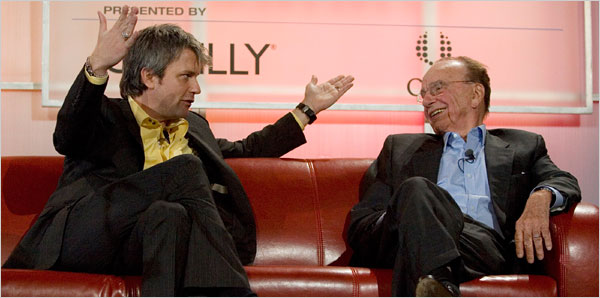
Three years ago today, Rupert Murdoch bought MySpace and its parent company Intermix for $580 million. That turned out to be money well spent. The last time we ran the numbers, we figured that MySpace alone is worth between $3 billion and $20 billion, depending on how much you value each user. Fox Interactive Media (which is mostly MySpace) accounted for about $850 million in revenues last fiscal year (which ended in June), and is projected to hit $1 billion next year.
It was supposed to hit $1 billion this year, but never mind. Unlike other social networks, MySpace is actually making a profit. The company now employs 1,600 people worldwide, compared to 150 in October, 2005—more than a tenfold increase.
The social network has grown as well. MySpace now has 73 million unique visitors a month in the U.S., according to comScore, compared to 24 million three years ago. (Facebook has 41 million). That means MySpace reaches about 40 percent of the online population, compared to 14 percent three years ago. Those visitors, on average, spend 263 minutes a month each on the site, versus 83 minutes in 2005.
MySpace has definitely evolved since 2005. Just this year it has made major strides in opening up its platform to developers, launching MySpace Music, and pushing new forms of social advertising.
The question is whether rival Facebook can catch up to MySpace in the U.S. (it has already surpassed it worldwide), or whether the two will co-exist and diverge, with MySpace being more music- and media-oreinted and Facebook continuing on its path towards becoming the platform for social software. Of course, MySpace would also like to play that role.
Three years from now, which one will be worth more? And will Rupert Murdoch still be smiling?
Tuesday, October 14, 2008
Bush critic wins 2008 Nobel for economics
STOCKHOLM (Reuters) - U.S. economist Paul Krugman, a fierce critic of the Bush administration for policies that he argues led to the current financial crisis, won the 2008 Nobel prize for economics on Monday.
The Nobel committee said the award was for Krugman's work that helps explain why some countries dominate international trade, starting with research published nearly 30 years ago.
While the research for which he won the prize was not obviously partisan, Krugman is best known as the author of columns and a blog called "The Conscience of a Liberal" for the New York Times. He has long been tipped as a likely winner.
A professor at Princeton University, the 55-year-old Krugman argues that President George W. Bush's zeal for deregulation and loose fiscal policies helped spark the current banking meltdown.
He said news of the prize took him by surprise. "I took the call stark naked as I was about to step into the shower," he told a news conference at Princeton on Monday afternoon.
Speaking by telephone to a news conference earlier, Krugman offered a snap analysis on the turbulent times.
"We are now witnessing a crisis that is as severe as the crisis that hit Asia in the 90s. This crisis bears some resemblance to the Great Depression."
Praising world leaders' efforts to staunch the financial bleeding, particularly in Europe, he added: "I'm slightly less terrified today than I was on Friday."
World policy makers met at the weekend, after a black week on financial markets, to agree on radical measures to rescue banks, revive liquidity and avert a global recession.
It was the second year in a row that a major Nobel prize was awarded to an American known for his strong criticism of Bush -- last year's peace prize went to former U.S. Vice President Al Gore for his work on climate change.
Asked at the Princeton news conference if he saw a trend of Nobels going to people who were anti-Bush, Krugman said "A lot of intellectuals are anti-Bush."
The prize committee dismissed any suggestion its choice was influenced by the current crisis or political considerations.
"I don't think the committee has ever taken a political stance," committee secretary Peter Englund told Reuters. "The real, dramatic crisis is an event of the last month or so, which is in practice after the committee took its decision."
COMMON SENSE VOICE
Krugman's latest column in the New York Times, published on Monday, praised Britain for thinking clearly and acting quickly to address the crisis, unlike the United States. He mused: Did British leader Gordon Brown just save world markets?
Britain unveiled a plan last week to bolster ailing banks, and on Monday it waded in with 37 billion pounds ($64 billion) of capital, a move that could make the state the banks' main owner.
Readers of Krugman's blog posted hundreds of comments congratulating him as an accessible voice of common sense.
"Sometimes it feels as though you are the only sane person in America," said a writer who identified himself as Martin Gruner Larsen.
Krugman said he was encouraged by recent steps to address the crisis and said it was vital there should be a combination of capital injection and guarantees for banks.
Commenting on policy proposals from the two U.S. presidential candidates, he said: "It would be kind of nice if we did have a sophisticated government, but that may change."
Asked about accountability for the crisis, Krugman said the financial system had outgrown the regulatory system.
"There is a lot of grotesque greed under this crisis but greed isn't illegal," he said.
The Royal Swedish Academy of Sciences said the prestigious 10 million crown ($1.4 million) award recognized Krugman's formulation of a new theory that addresses what drives worldwide urbanization.
"He has thereby integrated the previously disparate research fields of international trade and economic geography," the committee said. "Krugman's approach is based on the premise that many goods and services can be produced more cheaply in a long series, a concept generally known as economies of scale."
Krugman's theory clarifies why trade is dominated by countries that not only have similar conditions but also trade in similar products.
The Nobel committee said the award was for Krugman's work that helps explain why some countries dominate international trade, starting with research published nearly 30 years ago.
While the research for which he won the prize was not obviously partisan, Krugman is best known as the author of columns and a blog called "The Conscience of a Liberal" for the New York Times. He has long been tipped as a likely winner.
A professor at Princeton University, the 55-year-old Krugman argues that President George W. Bush's zeal for deregulation and loose fiscal policies helped spark the current banking meltdown.
He said news of the prize took him by surprise. "I took the call stark naked as I was about to step into the shower," he told a news conference at Princeton on Monday afternoon.
Speaking by telephone to a news conference earlier, Krugman offered a snap analysis on the turbulent times.
"We are now witnessing a crisis that is as severe as the crisis that hit Asia in the 90s. This crisis bears some resemblance to the Great Depression."
Praising world leaders' efforts to staunch the financial bleeding, particularly in Europe, he added: "I'm slightly less terrified today than I was on Friday."
World policy makers met at the weekend, after a black week on financial markets, to agree on radical measures to rescue banks, revive liquidity and avert a global recession.
It was the second year in a row that a major Nobel prize was awarded to an American known for his strong criticism of Bush -- last year's peace prize went to former U.S. Vice President Al Gore for his work on climate change.
Asked at the Princeton news conference if he saw a trend of Nobels going to people who were anti-Bush, Krugman said "A lot of intellectuals are anti-Bush."
The prize committee dismissed any suggestion its choice was influenced by the current crisis or political considerations.
"I don't think the committee has ever taken a political stance," committee secretary Peter Englund told Reuters. "The real, dramatic crisis is an event of the last month or so, which is in practice after the committee took its decision."
COMMON SENSE VOICE
Krugman's latest column in the New York Times, published on Monday, praised Britain for thinking clearly and acting quickly to address the crisis, unlike the United States. He mused: Did British leader Gordon Brown just save world markets?
Britain unveiled a plan last week to bolster ailing banks, and on Monday it waded in with 37 billion pounds ($64 billion) of capital, a move that could make the state the banks' main owner.
Readers of Krugman's blog posted hundreds of comments congratulating him as an accessible voice of common sense.
"Sometimes it feels as though you are the only sane person in America," said a writer who identified himself as Martin Gruner Larsen.
Krugman said he was encouraged by recent steps to address the crisis and said it was vital there should be a combination of capital injection and guarantees for banks.
Commenting on policy proposals from the two U.S. presidential candidates, he said: "It would be kind of nice if we did have a sophisticated government, but that may change."
Asked about accountability for the crisis, Krugman said the financial system had outgrown the regulatory system.
"There is a lot of grotesque greed under this crisis but greed isn't illegal," he said.
The Royal Swedish Academy of Sciences said the prestigious 10 million crown ($1.4 million) award recognized Krugman's formulation of a new theory that addresses what drives worldwide urbanization.
"He has thereby integrated the previously disparate research fields of international trade and economic geography," the committee said. "Krugman's approach is based on the premise that many goods and services can be produced more cheaply in a long series, a concept generally known as economies of scale."
Krugman's theory clarifies why trade is dominated by countries that not only have similar conditions but also trade in similar products.
Monday, October 13, 2008
Scientist warns: Financial crisis will be 'devastating' to science
LITTLE ROCK, Arkansas — Famed scientist Richard Leakey warned that the worldwide credit crisis will be "just devastating" to scientific research in coming years, as endowment interest income drops and companies cut donations.
Leakey, who once served on a government economic team in his native Kenya, said much of the support for science comes from wealthy philanthropists, foundations and companies. All those groups likely will be affected by lowered interest rates and the squeeze of credit not being available to fund their operations, he said.
"With the investment portfolios being hit as hard as they've been hit in the last few weeks, particularly the last few days, I would have thought there would be a very dramatic reduction in available funds for research in all sorts of countries," Leakey told reporters Wednesday. "Unless they bring it under control, I think it's going to spread. I think it's extremely worrying for science."
Leakey became famous after making a number of fossil discoveries in East Africa. His team unearthed the bones of the most complete skeleton of a prehistoric human ever found in the desolate, far northern reaches of Kenya in 1984.
The effect of the credit crisis on science likely will begin to be felt as organizations begin planning their budgets for 2009, Leakey said. The paleontologist said donations will be "hugely hit," affecting what research and exploration can be done next year and into the future.
FIND MORE STORIES IN: Kenya | Little Rock | University of Arkansas | East Africa | Ice Age | Financial | Richard Leakey
"This has spread right across the world and there's quite a lot of science to be supported," Leakey said. "I think it is just devastating.
"It's more worryful for people who are losing their homes, it's more worryful for people who are losing investments for their children's futures, but we're also very worried as scientists," he said.
Leakey was in Little Rock to speak at the University of Arkansas at Little Rock.
In a new book, Leakey offers a stark warning for the planet, saying global warming could wipe out endangered species living in national parks and refuges throughout the world. He said the extinction of a few species could destroy food chains supporting many other animals — including humans.
"I think the end of the Ice Age was a quite a massive change and I think this will be ... almost as big of a change in the way we live," Leakey said.
Leakey, who once served on a government economic team in his native Kenya, said much of the support for science comes from wealthy philanthropists, foundations and companies. All those groups likely will be affected by lowered interest rates and the squeeze of credit not being available to fund their operations, he said.
"With the investment portfolios being hit as hard as they've been hit in the last few weeks, particularly the last few days, I would have thought there would be a very dramatic reduction in available funds for research in all sorts of countries," Leakey told reporters Wednesday. "Unless they bring it under control, I think it's going to spread. I think it's extremely worrying for science."
Leakey became famous after making a number of fossil discoveries in East Africa. His team unearthed the bones of the most complete skeleton of a prehistoric human ever found in the desolate, far northern reaches of Kenya in 1984.
The effect of the credit crisis on science likely will begin to be felt as organizations begin planning their budgets for 2009, Leakey said. The paleontologist said donations will be "hugely hit," affecting what research and exploration can be done next year and into the future.
FIND MORE STORIES IN: Kenya | Little Rock | University of Arkansas | East Africa | Ice Age | Financial | Richard Leakey
"This has spread right across the world and there's quite a lot of science to be supported," Leakey said. "I think it is just devastating.
"It's more worryful for people who are losing their homes, it's more worryful for people who are losing investments for their children's futures, but we're also very worried as scientists," he said.
Leakey was in Little Rock to speak at the University of Arkansas at Little Rock.
In a new book, Leakey offers a stark warning for the planet, saying global warming could wipe out endangered species living in national parks and refuges throughout the world. He said the extinction of a few species could destroy food chains supporting many other animals — including humans.
"I think the end of the Ice Age was a quite a massive change and I think this will be ... almost as big of a change in the way we live," Leakey said.
Sunday, October 12, 2008
Stock market drops 107 points during Bush’s speech on the economy.»
Today, President Bush gave an eight-minute speech on the economy, which was meant to reassure the markets. “This is an anxious time,” said Bush. “But the American people can be confident in our economic future.” However, ABC News notes that during those eight minutes, the Dow Jones dropped another 107 points. The Dow was down 78.70 at the beginning of Bush’s address, but at 185.66 by the end.
Saturday, October 11, 2008
US climate fix could help solve financial crisis
If the US focused on curbing climate change as soon as a new president took office – or sooner – it could help pull the world from the financial brink, according to environmental policy experts.
"Skyrocketing energy prices and the financial crisis have been a wake-up call that something's got to change," says Cathy Zoi, chief executive officer of the Alliance for Climate Protection, which is chaired by former US vice president Al Gore.
"My very strong belief is that we need to reorient our investments toward this transition to a clean energy economy, and it will be the engine of growth for getting us out of the doldrums that we've gotten in right now," says Zoi.
The reorientation must include limits on emissions of climate-warming carbon in the US, she said: "Unless we take action at home, we're not going to be able to have much influence in the international arena about what gets done."
The Bush administration accepts that human-spurred climate change is a reality, but rejects mandatory across-the-board caps on carbon as a disadvantage when competing with fast-growing, big-emitting countries like China and India.
The US is alone among the major developed countries in staying out of the carbon-capping Kyoto protocol, but is part of international discussions on new targets to fight climate change, due to be finalised in Copenhagen at the end of 2009.
Both major US presidential candidates– Democrat Barack Obama and Republican John McCain – favour requiring reductions in greenhouse emissions, and environmental activists says whoever wins the White House in the 4 November elections will be an improvement over president George W Bush.
"There is an urgent need for whichever party wins the US election to give an early signal [of an intent to do more to combat global warming], or there cannot be a credible reason for 190 nations to come together in Copenhagen," says Achim Steiner, head of the UN Development Programme.
Rajendra Pachauri, who shared the 2007 Nobel Peace Price with Gore and who chairs the UN Intergovernmental Panel on Climate Change, says an Obama presidency would probably be more favourable to the fight against climate change.
But he adds: "Even if McCain wins, he has been very committed."
There is little chance of passing a US law to mandate a programme to cap and trade carbon emissions before Bush leaves office in January.
However, the first draft of a cap-and-trade bill was released this week by US Democratic representatives John Dingell of Michigan – home of the Big Three auto manufacturers – and Rick Boucher of Virginia – coal-mining country – that is likely to frame debate next year.
The draft legislation drew measured applause from environmental activists, who noted it contains options that could substantially weaken controls on greenhouse emissions from some sectors.
But the fact that these two law makers are crafting legislation aimed at curbing climate change indicates a possible change in tone in Washington.
"Skyrocketing energy prices and the financial crisis have been a wake-up call that something's got to change," says Cathy Zoi, chief executive officer of the Alliance for Climate Protection, which is chaired by former US vice president Al Gore.
"My very strong belief is that we need to reorient our investments toward this transition to a clean energy economy, and it will be the engine of growth for getting us out of the doldrums that we've gotten in right now," says Zoi.
The reorientation must include limits on emissions of climate-warming carbon in the US, she said: "Unless we take action at home, we're not going to be able to have much influence in the international arena about what gets done."
The Bush administration accepts that human-spurred climate change is a reality, but rejects mandatory across-the-board caps on carbon as a disadvantage when competing with fast-growing, big-emitting countries like China and India.
The US is alone among the major developed countries in staying out of the carbon-capping Kyoto protocol, but is part of international discussions on new targets to fight climate change, due to be finalised in Copenhagen at the end of 2009.
Both major US presidential candidates– Democrat Barack Obama and Republican John McCain – favour requiring reductions in greenhouse emissions, and environmental activists says whoever wins the White House in the 4 November elections will be an improvement over president George W Bush.
"There is an urgent need for whichever party wins the US election to give an early signal [of an intent to do more to combat global warming], or there cannot be a credible reason for 190 nations to come together in Copenhagen," says Achim Steiner, head of the UN Development Programme.
Rajendra Pachauri, who shared the 2007 Nobel Peace Price with Gore and who chairs the UN Intergovernmental Panel on Climate Change, says an Obama presidency would probably be more favourable to the fight against climate change.
But he adds: "Even if McCain wins, he has been very committed."
There is little chance of passing a US law to mandate a programme to cap and trade carbon emissions before Bush leaves office in January.
However, the first draft of a cap-and-trade bill was released this week by US Democratic representatives John Dingell of Michigan – home of the Big Three auto manufacturers – and Rick Boucher of Virginia – coal-mining country – that is likely to frame debate next year.
The draft legislation drew measured applause from environmental activists, who noted it contains options that could substantially weaken controls on greenhouse emissions from some sectors.
But the fact that these two law makers are crafting legislation aimed at curbing climate change indicates a possible change in tone in Washington.
Subscribe to:
Comments (Atom)

 Posts
Posts


