A would-be gangster shot himself in the crutch when his gun went off half cocked in his pocket.
Lukas Neuhardt, 27, had forgotten to put the safety catch on when he stuffed the gun into his trouser pocket to impress pals in Saarbruecken, Germany.
He told paramedics that a masked mugger had blasted him in the crutch in a bungled robbery.
But police found a hole in his statement when they saw that the gunshot had miraculously left his trousers intact.
"Instead there was a charred hole in his pocket so either it was the shot of the century or he did it himself," said a police source.
Now - after surgeons stitched his manhood back together - he's facing up to three years in jail for breaching Germany's tough new anti gun laws.
Tuesday, May 26, 2009

Scientists discover 'genes that slow ageing process'
Mutations have been found to extend the lifespan of animals in the lab such as worms, fruit flies and mice, and appear to play the same role in humans.
Professor Linda Partridge, director of the Institute of Healthy Ageing at University College London, said such research could help treat or delay many diseases simultaneously with medication.
She believes these scientific advances are offering hope to improve health during ageing in humans and inspiring a new wave in ageing research.
So far, "pathways" in the human body along which nutrients pass have proved to have the most robust effect on healthy lifespan.
Prof Partridge, who will present a public lecture at the Royal Society in London on Tuesday, said tackling the very causes of ageing - rather than treating the symptoms "piecemeal" - offers the best prospects for dealing with the diseases.
She said: "Research on the diseases associated with ageing is generally done by separate communities of research workers who read different journals, attend different conferences and generally do not communicate with each other.
"But by tacking the causes of ageing itself we could treat, or at least delay, a broad spectrum of conditions simultaneously."
Prof Partridge said in mammals, insulin regulates blood sugar levels and metabolism in response to food intake, while the related insulin-like growth factor 1 (Igf1) regulates growth.
Mutations in genes that encode the protein components of the insulin and Igf1 signalling pathways have proved to extend lifespan in a nematode worm, the fruit fly and mice, and genetic variants for these genes in humans have proved to be associated with lifespan.
Dietary restriction, which is a simple environmental intervention, can also extend life in a range of animals.
Drugs which inhibit the nutrient pathways in humans could replicate the effects of dietary restriction and act not only to increase healthy lifespan but to target a broad range of ageing related diseases such as cardiovascular disease, cancers, diabetes and Alzheimer's.
Prof Partridge said this research means a new approach to the treatment of age-related conditions.
She added: "The major burden of ill health is in the older section of the population.
"The new discoveries about ageing have raised the prospect of increasing the number of years that people enjoy in good health, with broad-spectrum preventive medicines for the diseases of ageing."
Professor Linda Partridge, director of the Institute of Healthy Ageing at University College London, said such research could help treat or delay many diseases simultaneously with medication.
She believes these scientific advances are offering hope to improve health during ageing in humans and inspiring a new wave in ageing research.
So far, "pathways" in the human body along which nutrients pass have proved to have the most robust effect on healthy lifespan.
Prof Partridge, who will present a public lecture at the Royal Society in London on Tuesday, said tackling the very causes of ageing - rather than treating the symptoms "piecemeal" - offers the best prospects for dealing with the diseases.
She said: "Research on the diseases associated with ageing is generally done by separate communities of research workers who read different journals, attend different conferences and generally do not communicate with each other.
"But by tacking the causes of ageing itself we could treat, or at least delay, a broad spectrum of conditions simultaneously."
Prof Partridge said in mammals, insulin regulates blood sugar levels and metabolism in response to food intake, while the related insulin-like growth factor 1 (Igf1) regulates growth.
Mutations in genes that encode the protein components of the insulin and Igf1 signalling pathways have proved to extend lifespan in a nematode worm, the fruit fly and mice, and genetic variants for these genes in humans have proved to be associated with lifespan.
Dietary restriction, which is a simple environmental intervention, can also extend life in a range of animals.
Drugs which inhibit the nutrient pathways in humans could replicate the effects of dietary restriction and act not only to increase healthy lifespan but to target a broad range of ageing related diseases such as cardiovascular disease, cancers, diabetes and Alzheimer's.
Prof Partridge said this research means a new approach to the treatment of age-related conditions.
She added: "The major burden of ill health is in the older section of the population.
"The new discoveries about ageing have raised the prospect of increasing the number of years that people enjoy in good health, with broad-spectrum preventive medicines for the diseases of ageing."
Free boob jobs offered to nurses at Prague clinic
AN understaffed Prague clinic has signed up nurses by offering boob jobs, liposuction and tummy tucks as a bonus.
Nurses, doctors and secretaries who sign up with the small private clinic for three years can choose their free plastic surgery.
"It has been a success," Jiri Schweitzer, a manager at the Iscare clinic, said, adding the establishment was now fully staffed and had to reject dozens of beauty-hunting job applicants.
Petra Kalivodova, a 31-year-old nurse who has been working at the clinic for four years, has had a breast implants - the most popular choice among nurses - so she underwent liposuction for her signing on perk.
"I have mentioned this to colleagues and friends, and the interest in working here is huge," she said.
The clinic charges up to 75,000 koruna ($5060) for a breast implant, almost three times the average nurse's monthly wage, and up to €1880 ($3380) for liposuction.
Many Czech nurses have been tempted out of the country by higher wages offered in western European nations and the Czech health system now needs about 6000 nurses in addition to the 90,000 it already employs, according to official data.
Nurses, doctors and secretaries who sign up with the small private clinic for three years can choose their free plastic surgery.
"It has been a success," Jiri Schweitzer, a manager at the Iscare clinic, said, adding the establishment was now fully staffed and had to reject dozens of beauty-hunting job applicants.
Petra Kalivodova, a 31-year-old nurse who has been working at the clinic for four years, has had a breast implants - the most popular choice among nurses - so she underwent liposuction for her signing on perk.
"I have mentioned this to colleagues and friends, and the interest in working here is huge," she said.
The clinic charges up to 75,000 koruna ($5060) for a breast implant, almost three times the average nurse's monthly wage, and up to €1880 ($3380) for liposuction.
Many Czech nurses have been tempted out of the country by higher wages offered in western European nations and the Czech health system now needs about 6000 nurses in addition to the 90,000 it already employs, according to official data.
Sunday, May 24, 2009
Netherlands to close prisons for lack of criminals
The Dutch justice ministry has announced it will close eight prisons and cut 1,200 jobs in the prison system. A decline in crime has left many cells empty.
During the 1990s the Netherlands faced a shortage of prison cells, but a decline in crime has since led to overcapacity in the prison system. The country now has capacity for 14,000 prisoners but only 12,000 detainees.
Deputy justice minister Nebahat Albayrak announced on Tuesday that eight prisons will be closed, resulting in the loss of 1,200 jobs. Natural redundancy and other measures should prevent any forced lay-offs, the minister said.
The overcapacity is a result of the declining crime rate, which the ministry's research department expects to continue for some time.
Belgian prisoners
Some reprieve might come from a deal with Belgium, which is facing overpopulation in its prisons. The two countries are working out an agreement to house Belgian prisoners in Dutch prisons. Some five-hundred Belgian prisoners could be transferred to the Tilburg prison by 2010.
The Netherlands would get 30 million euros in the deal, and it will allow the closing of the prisons in Rotterdam and Veenhuizen to be postponed until 2012.
During the 1990s the Netherlands faced a shortage of prison cells, but a decline in crime has since led to overcapacity in the prison system. The country now has capacity for 14,000 prisoners but only 12,000 detainees.
Deputy justice minister Nebahat Albayrak announced on Tuesday that eight prisons will be closed, resulting in the loss of 1,200 jobs. Natural redundancy and other measures should prevent any forced lay-offs, the minister said.
The overcapacity is a result of the declining crime rate, which the ministry's research department expects to continue for some time.
Belgian prisoners
Some reprieve might come from a deal with Belgium, which is facing overpopulation in its prisons. The two countries are working out an agreement to house Belgian prisoners in Dutch prisons. Some five-hundred Belgian prisoners could be transferred to the Tilburg prison by 2010.
The Netherlands would get 30 million euros in the deal, and it will allow the closing of the prisons in Rotterdam and Veenhuizen to be postponed until 2012.
Burning Question: Why Isn't Wireless Net Access Available Everywhere?

You might remember a time when everyone—from telco giants to corner coffee shops—was furiously serving up Wi-Fi. McDonald's became an Internet café, and dozens of municipalities nationwide were racing to set up open hot spots. Your broadband connection was about to be as portable as your cell phone. That was like five years ago.
What happened next? Zilch. "There has been a complete lack of leadership from the regulatory agencies, service providers, and device makers," says Ashvin Vellody, senior vice president for enabling technologies at communications research firm Yankee Group. Fortunately, cellular providers are stepping up to fill the motivational vacuum. Omnipresent broadband access is almost here. Again. Really.
Even skeptics have to concede that the odds look pretty good this time. The technology won't be your familiar 802.11—it never had the bandwidth or range to be viable anyway. The airwaves will instead be paved with a new generation of wireless broadband. Some of these so-called 4G networks will use the 700-MHz spectrum that the government auctioned off last year, and they promise to blanket every medium to large city in Net-ready radio waves.
It's about time. Cell phone companies have been asleep at the wheel for years, loath to upgrade to expensive new networks when their old ones "work just fine." The iPhone slapped them awake. Before Apple's smooth-talker, portable broadband didn't look juicy enough to chase—cellular data usage was slim. But the typical iPhone owner uses five times more data than the average cell user. "It took Apple and its ecosystem of apps and interactivity to prove the pent-up demand for ubiquitous broadband," Vellody says.
And now, mobile devices like netbooks and Google phones have joined in to force the issue. Clearwire introduced a WiMax service in Baltimore and Portland, Oregon, with a commitment to add 80 more markets by the end of 2010. Verizon is testing a related technology, Long Term Evolution, and aims to roll out coverage by 2010; Motorola, Sony Ericsson, and Nokia are all building compatible devices. Both WiMax and LTE will offer about the same DSL-ish speed (5-6 Mbps), but bitrates could grow to 15 Mbps by 2012.
Unfortunately, the current economic malaise is slowing some capital expansion plans. (How convenient.) "It won't be overnight, but you're eventually going to see mobile broadband replace your at-home connection," says Barry West, Clearwire's president and chief architect. A bright forecast—but believe it when you actually see the sun.
Woman Who is Allergic to Modern Technology

For most people talking on a mobile phone, cooking dinner in the microwave or driving in a car is simply part of modern living in 21st century Britain. But completing any such tasks is impossible for Debbie Bird - because she is allergic to Cell Phones and Microwaves.
The 39-year-old is so sensitive to the electromagnetic field (emf) or 'smog' created by computers, mobile phones, microwave ovens and even some cars, that she develops a painful skin rash and her eyelids swell to three times their size if she goes near them. As a consequence, Mrs Bird, a health spa manager, has transformed her home into an EMF-free zone to try and stay healthy. 'I can no longer do things that I used to take for granted,' Mrs Bird said. "My day-to-day life has been seriously affected by EMF"..
Saturday, May 16, 2009
Real Archaeologist Digs Up Fact, Fiction of 'Angels & Demons'

Antimatter!
Early on in the movie a potentially catastrophic vial of antimatter is stolen from CERN setting the plot in motion. Antimatter sounds like a fantasy sci-fi movie product, but it has been created -- at the cost of about $1,772 trillion per ounce. Why? Because it takes enormous energy to create in particle accelerators like CERN. (Remember CERN is the European Organization for Nuclear Research. They've got the huge underground particle accelerator that was supposed to create a black hole and swallow the earth last fall, until an accident took everything offline. Cross your fingers for this fall, when they start the accelerator up again.)
The only reassuring news about antimatter besides its prohibitive cost? The fact that, at this point, there's no way to store it, much less broadcast it on the Internet.
After the jump, learn the truth about the Vatican's leadership and the badass-itude of the Swiss Guard.
The Vatican Leadership
Oh Vatican, oh Vatican, who's the most murderous of them all? Yep, probably because of the lousy press from the Catholic Church that followed "The Da Vinci Code," this film played nice with Catholicism's major domos. But in real life, popes and cardinals haven't been innocent when it comes to murder, bribery, rape, incest, etc. Around the time that so many of the fantastic churches in the film were built, for instance, there was Pope Alexander VI (d. 1503). Known as the "STD Pope," Alex allegedly committed his first murder at 12, slept with his daughter, and died drinking poison intended for a potential cardinal.
The Illuminati
OK, here's the problem with the secret society chronology in this movie: most of the groups we're familiar with today, like the Freemasons and the Illuminati, were founded during the Age of Enlightenment, which began in the 1700s. In fact, the Illuminati were founded in 1776 -- a good 100-150 years after the characters (Galileo, Bernini) mentioned in "Angels & Demons" existed. (By the way, the original Illuminati preferred to call themselves the "Perfectibilists," and "The Order of the Bees," neither of which is nearly as sexy or intimidating.)
Other, earlier "secret societies" known to pose a threat to the Church, like the Knights Templar, were ruthlessly stamped out by popes in the 1300s. So poor A&D author Dan Brown was essentially left with a secret society "dead zone" from 1400 to 1700 -- the time of Galileo.
The Swiss Guard
Let's talk about how badass the Swiss Guard is. Would you mess with a Chechen, a Colombian, or an Afghani? Multiply that by 10 and we have the Swiss. Crazy-ass, take-no-hostages mountain people -- these are the men who have ruthlessly guarded the Vatican for 500 years. And those nasty-looking halberds they carry? Renowned since the 16th century for efficiently piercing human skulls. They also carry assault rifles. So don't make fun of their striped pajamas and funny hats the next time you find yourself in Rome.
Symbology
... is a load of crap. I'd love to teach it at Harvard too, but what our esteemed professor Dr. Robert Langdon does is actually some weird combo of western art history and anthropology.
Why is it impossible to teach "symbology"? Because those two crossed keys that mean "Vatican" in the West may mean something entirely different in say, Vietnam. And the whole elements-of-the-earth spiel that works for Langdon in Rome may mean nothing in the Peruvian desert. To be a symbologist, he'd have to have in-depth knowledge of all of the world's cultures in order to properly interpret symbols, which is impossible unless you're Stephen Hawking. Our dear Harvard professor doesn't even know Italian, for Pete's sake.
Kristin Romey is an anthropologist, explorer, former executive editor of Archeology Magazine and, most prestigiously, Asylum's scientific adviser.
Tuesday, May 12, 2009
Intelligent women enjoy sex more than 'bimbos', research finds
A study of more than 2,000 female twins showed that those with greater emotional intelligence had larger numbers of orgasms.
Emotional intelligence (EI) is the ability to monitor and manage feelings and emotions in oneself and others.
The findings suggest that low EI is a risk factor for female orgasmic disorder, one of the most common sexual problems suffered by women.
Up to 30 per cent of women find it difficult or impossible to reach a climax during sexual intercourse.
Professor Tim Spector, director of the Twin Research Department at King's College London and co-author of the study, said: "These findings show that emotional intelligence is an advantage in many aspects of your life including the bedroom. This study will help enormously in the development of behavioural and cognitive therapies to improve women's sexual lives."
A total of 2,035 female volunteers from the TwinsUK registry were recruited for the study, ranging in age from 18 to 83.
The registry consists of adult twins who have agreed to take part in studies to investigate the causes of common disorders. Using twins makes it possible to disentangle genetic and environmental risk factors.
All participants completed questionnaires giving details of their sexual behaviour and performance and also answered questions designed to test their emotional intelligence.
A significant association was found between EI and frequency of orgasm both during masturbation and sexual intercourse.
Women in the bottom 25 per cent of the emotional intelligence range had twice the normal risk of infrequent orgasm.
The results of the study appear today in The Journal of Sexual Medicine.
Lead author, psychologist Andrea Burri, also from King's College, said: "Emotional intelligence seems to have a direct impact on women's sexual functioning by influencing her ability to communicate her sexual expectations and desires to her partner."
She added that there was a possible connection with a woman's ability to fantasise during sexual intercourse.
"Emotional intelligence seems to have a direct impact on women's sexual functioning by influencing her ability to communicate her sexual expectations and desires to her partner," said Ms Burri.
Emotional intelligence (EI) is the ability to monitor and manage feelings and emotions in oneself and others.
The findings suggest that low EI is a risk factor for female orgasmic disorder, one of the most common sexual problems suffered by women.
Up to 30 per cent of women find it difficult or impossible to reach a climax during sexual intercourse.
Professor Tim Spector, director of the Twin Research Department at King's College London and co-author of the study, said: "These findings show that emotional intelligence is an advantage in many aspects of your life including the bedroom. This study will help enormously in the development of behavioural and cognitive therapies to improve women's sexual lives."
A total of 2,035 female volunteers from the TwinsUK registry were recruited for the study, ranging in age from 18 to 83.
The registry consists of adult twins who have agreed to take part in studies to investigate the causes of common disorders. Using twins makes it possible to disentangle genetic and environmental risk factors.
All participants completed questionnaires giving details of their sexual behaviour and performance and also answered questions designed to test their emotional intelligence.
A significant association was found between EI and frequency of orgasm both during masturbation and sexual intercourse.
Women in the bottom 25 per cent of the emotional intelligence range had twice the normal risk of infrequent orgasm.
The results of the study appear today in The Journal of Sexual Medicine.
Lead author, psychologist Andrea Burri, also from King's College, said: "Emotional intelligence seems to have a direct impact on women's sexual functioning by influencing her ability to communicate her sexual expectations and desires to her partner."
She added that there was a possible connection with a woman's ability to fantasise during sexual intercourse.
"Emotional intelligence seems to have a direct impact on women's sexual functioning by influencing her ability to communicate her sexual expectations and desires to her partner," said Ms Burri.
Saturday, April 25, 2009
Learn How You'll Die For Only $68,000

No doubt you have it on your calendars, but in case you forgot, the 25th is National DNA Day. Can't think how to celebrate it? Well, if you have $68,000 or more lying around, you can bid for a chance to have your entire personal genome sequenced by Knome, a company that does such things.
The proceeds from the ten-day auction will benefit the X-Prize Foundation, whose mission is to "bring about radical breakthroughs for humanity." They've put up a prize of $10 million to anyone who can sequence 100 human genomes in 10 days or less. Considering that the first sequencing of the human genome, back in 2001, took an entire year, this will prove to be a remarkable feat.
According to Dr. Peter H. Diamandis, chairman and CEO of the X-Prize Foundation, "The ability to fully sequence human genomes and use that personal genetic information to predict disease susceptibility and guide proactive care has the power to transform our entire healthcare system. It is that quantum jump in speed and reduction of cost that make this X-Prize so important in accelerating the dawn of personalized medicine," says Diamandis.
Oh, one more thing... your personal genome will be delivered to you in a silver box containing a brushed steel USB flash drive. Happy bidding!
Usher Teams With U.N. For Malaria Campaign
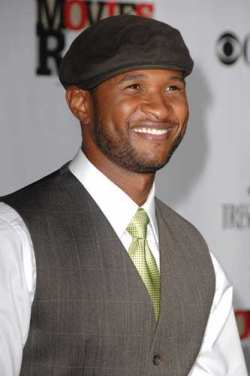
R&B star Usher is fronting a United Nations drive to fight malaria in Africa.
The Yeah! hitmaker has teamed up with the United Nations Foundation to launch the Nothing But Nets campaign, urging underprivileged youths to become more pro-active and make a difference in global issues.
The initiative aims to raise money to prevent African kids contracting the deadly disease by providing more mosquito nets to civilians.
Malaria is usually spread by mosquito bites.
Usher says, "I am proud to be a part of an exciting partnership with the United Nations Foundation and its Nothing But Nets campaign.
This initiative sends an important message youth, regardless of their backgrounds,can make a difference in this world by taking action through service to save lives. Anyone can make a difference. All it takes is $10 to send a net and save a life".
Anyone can make a difference
Subscribe to:
Posts (Atom)

 Posts
Posts


